Today's
EarthStation1.com 15% (Or More!) Off Commemorative Memorial Title:
Old Time Radio Children's Show MP3 MegaSet DVD, Download, USB
Stick
Today, August 9, 2026
August 9: Melon Day: -- Watermelons are a
particular favorite summer fruit in the United States; so are
Cantaloupes and Honeydews -- but there are so many different kinds
of melons to choose from: Galias, Canarys, Musks - the list goes
on and on! These are the fruits we celebrate on Melon Day, a day
dedicated to all forms of melons. If you're a lover of fresh crisp
melon on a hot day, then you already know why it deserves a day of
its own! Melon Day started off as a holiday in Turkmenistan.
However, it has now been honored in many different places around
the world. Today's your day to try a variety of melon that you
have never tried before! The Turkmenbashi melon, in particular,
has been praised for its large size, taste, and aroma. It is a
type of muskmelon. Other varieties of muskmelon include casaba,
Crenshaw, and the ever-popular Honeydew. They are characterised by
their smooth skin and sweet fragrance. There are a lot of
different benefits that are associated with eating muskmelons in
particular. This includes the fact that they promote good
digestion. They also regulate blood pressure, promote hair growth,
improve skin healthy, and they are good for eyesight and also
immunity. These fruits are also very hydrating and they are filled
with different nutrients. So, not only do they taste good, but
they are going to add so many benefits to your diet. This is why
it makes sense to use Melon Day as the perfect opportunity to
indulge in this super tasty and highly beneficial fruit. You can
even spend some time learning a little bit more about different
kinds of melons, finding out where they have come from and the
sort of benefits they provide. Turkmenistan is a Central Asian
country on the shores of the Caspian Sea and has spent the
majority of its lifespan as the crossroads of civilization. In its
time it has served as an important trade stop between the West and
the East, and its city of Merv was of great import on the silk
road. On Sale Until Midnight Tonight PT!
https://store.earthstation1.com/old-time-radio-childrens-show-megaset-2-dual-layer-mp3-dvd-s23.html
Today's
EarthStation1.com 15% (Or More!) Off Commemorative Memorial Title:
Betty Boop: Boop-Oop-A-Doop With Steve Allen DVD, Download, USB
Drive
Today, August 9, 2026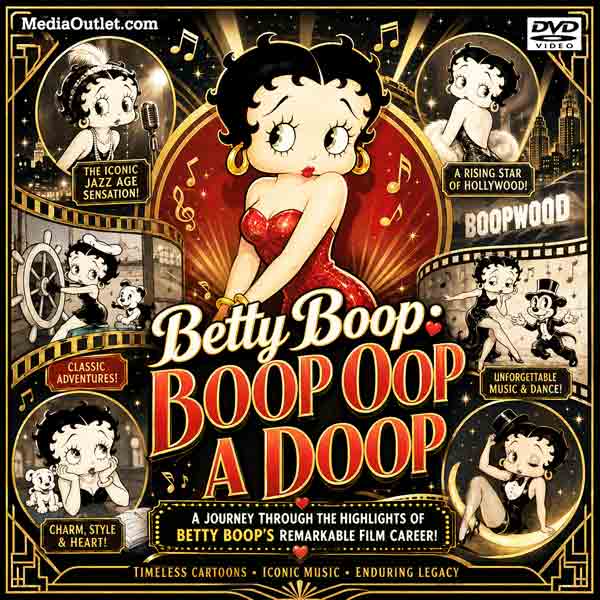
August 9: Betty Boop Day: -- August 9,
1930: Aesthetics: Performing Arts: Premieres: Animation Premieres:
American Animation Premieres: -- Betty Boop makes her cartoon
debut in Dizzy Dishes, an animated cartoon created by Fleischer
Studios in 1930, as part of the Talkartoon series. The cartoon
begins with four anthropomorphic flapper cats singing "Crazy
Town". Chef Bimbo waits on a hungry gorilla and then goes to
the kitchen to prepare the order, roast duck. When he is about to
bring it to the gorilla's table, he sees Betty Boop performing on
stage and falls in love at first sight. He forgets about the
hungry gorilla and dances on stage with the duck. The gorilla,
furious, goes after Bimbo, who escapes on a wooden train. The
as-yet-unevolved Betty Boop is drawn as an anthropomorphic female
dog. Except for the ears, she resembles Betty Boop in her latest
incarnation. Also, she is merely a side character; the main
plotline revolves around the incompetent chef Bimbo and the irate
gorilla. "Crazy Town," sung by the flapper cats in the
beginning of the cartoon, is also the theme song for the 1932 film
Crazy Town. Betty Boop is an animated cartoon character created by
Max Fleischer, with help from animators including Grim Natwick.
She originally appeared in the Talkartoon and Betty Boop film
series, which were produced by Fleischer Studios and released by
Paramount Pictures. She has also been featured in comic strips and
mass merchandising. A caricature of a Jazz Age flapper, Betty Boop
was described in a 1934 court case as: "combin[ing] in
appearance the childish with the sophisticated-a large round baby
face with big eyes and a nose like a button, framed in a somewhat
careful coiffure, with a very small body of which perhaps the
leading characteristic is the most self-confident little bust
imaginable". Despite having been toned down in the mid-1930s
as a result of the Hays Code to appear more demure, she became one
of the best-known and popular cartoon characters in the world. On
Sale Until Midnight Tonight PT!
https://store.earthstation1.com/betty-boop-boopoopadoop-dvd-steve-allen-documentary.html
Today's
EarthStation1.com 15% (Or More!) Off Commemorative Memorial Title:
NBC University Theater Of The Air Literature Radio Series MP3 DVD
USB
Today, August 9, 2026
August 9: National Book Lovers Day: -- An
annual harnessing of all the excitement bibliophiles feel about
books all year long into one celebration! A day for all those who
love to read, National Book Lovers Day encourages you to find your
favorite reading place, a good book (whether it be fiction or
non-fiction) and read the day away. The first books used parchment
or vellum (calf-skin) for the book pages. The covers were made of
wood and often covered with leather, and clasps or straps kept the
books closed. As libraries grew in size and number during the
Middle Ages, public and private libraries routinely chained the
books to a shelf or a desk to prevent theft, as a single book
could be worth an entire year's agricultural production of one
farmer. Many innovations occurred in the bookmaking process. Book
manufacturers now use digital printing. Book pages are printed
using toner rather than ink. As a result of digital printing,
print-on-demand opens up a whole new realm of publishing. In this
case, distributors don't print the books until the customer places
the order. More and more, people read E-books. E-book (electronic
book) refers to a book-length publication in digital form and
distributed via ecommerce, CD-ROM and other systems. And read as
an E-book on a computer or via a portable book display device
known as an e-book reader, such as a Reader, Nook or Kindle. To
observe National Book Lovers Day: Sit back, relax and READ! Don't
forget to share the joy of reading with young people in your life.
Inspire them with your favorite novel or find out about the last
book they took off the shelf. Read to the littlest of the
up-and-coming readers, too. Shop for a new title to read or
explore the shelves for one you would like to give. Explore the
shelves of used book stores. You might find an out-of-print tome
that might become the highlight of your collection. Discover the
world of online bookstores. Their stock includes a variety of
subjects and collectible items, too. Record a video of you reading
a story for a child in your life. Randomly give a book to someone.
Visit your public library and check out a favorite tome. And use
#NationalBookLoversDay to post on social media and spread the
word! On Sale Until Midnight Tonight PT!
https://store.earthstation1.com/nbc-university-theater-of-the-air-otr-mp3-dv3.html
Today's
EarthStation1.com 15% (Or More!) Off Commemorative Memorial Title:
Presidential Campaign TV Ads 1952-1992 MP4 Video Download 4 DVD
Set
Today, August 9, 2026
August 9: The National Veep Day: --
Recognizes and celebrates the American constitution related to
presidential succession matters. The day came to the attention of
the masses during the 1970s when President Richard Nixon resigned
following the Watergate scandal, and in his place, Gerald Ford was
announced as the new president of the U.S. This was the first time
in history that a president was sworn into the Oval Office without
being elected as president or vice president. Spiro Theodore
Agnew, who was the vice president during Nixon's presidency, had
resigned a year before Nixon's resignation, becoming the second
and most recent vice president to ever resign in the history of
the country. American history shows 14 vice presidents who became
presidents due to elections or the sudden deaths/resignations of
their presidents. Veep Day brings attention to the part of the
American constitution that deals with matters related to
presidential succession. Article II of Section 1's Clause 6
extensively talks about the processes the State must take before
it decides on a new president and/or vice president. The 25th
Amendment saw said clause being further clarified. All these
procedures were taken into account and implemented when Gerald
Ford was nominated as a vice presidential candidate to replace
Spiro Theodore Agnew, who resigned in 1973 due to a tax evasion
scandal. However, one year later, Ford was given the title of the
president of America after Nixon too resigned following Watergate.
The presidential succession constitution has gone through several
changes over the years. While today the vice president position is
decided by whoever wins the presidential election, this was not
always the case. Up until 1800, the vice president position went
to the person with the second-highest number of votes. Yet, in the
election term of 1800, Thomas Jefferson and Aaron Burr tied by
getting the second-highest number of votes. Such a situation led
to the twelfth Amendment changes, and people were allowed to vote
separately for their favorite vice president candidates. The
current Article II, Section 1, Clause 6 is the one that is used
today, and it goes as such: "In case of the removal of the
president from office, or of his death, resignation, or inability
to discharge the powers and duties of the said office, the same
shall devolve on the vice president, and the congress may by law
provide for the case of removal, death, resignation or inability,
both of the president and vice president, declaring what officer
shall then act as president, and such officer shall act
accordingly, until the disability be removed, or a president shall
be elected." On Sale Until Midnight Tonight PT!
https://store.earthstation1.com/presidential-campaign-tv-ads-19521984-dvds-2-dual-la195219842.html
Today's
EarthStation1.com 15% (Or More!) Off Commemorative Memorial Title:
Sweat Of The Sun: The Riches Of Ancient America DVD MP4 Video
Download
Today, August 9, 2026
August 9: International Day Of The
World's Indigenous People/Suriname Indigenous People's Day: --
Today pays tribute to the indigenous communities of the world. The
latest data reveals that there are about 370 to 500 million
indigenous people living in 90 countries. These communities are
noted to have their own unique set of languages, traditions,
cultures, and governing systems. For many indigenous groups, the
systems that their ancestors have followed for centuries have
stood the test of time by serving them with positive outcomes to
date. Many indigenous people's special bond and connection with
nature have also led to the protection of the general environment.
However, on the other side, several indigenous communities face
difficulties due to a central government's covert and overt
attempts to control their lives. This has led to indigenous
people's rights violations where they would have otherwise ensured
peaceful and harmonious lives for them. Suriname Indigenous
People's Day coincidies with the U.N.'s International Day of the
World's Indigenous Peoples, and celebrates Suriname's indigenous
people and their identity. It remembers the centuries of
oppression, slavery, and forced assimilation the indigenous people
went through and aims to make things right. On Sale Until Midnight
Tonight PT!
https://store.earthstation1.com/sweat-of-the-sun-the-riches-of-ancient-america-dvd-mp4-video-downloa4.html
Today's
EarthStation1.com 15% (Or More!) Off Commemorative Memorial Title:
1940-1960: Empires Crumble - End Of World Colonialism DVD, MP4,
USB
Today, August 9, 2026
August 9: Singapore National Day: --
August 9, 1965: The History Of Singapore: Singapore In Malaysia
(The State Of Singapore): Singapore's Forcible Independence From
Malaysia: Singapore becomes the only country to date to gain
independence unwillingly when it is expelled from The States And
Federal Territories Of Malaysia. The State of Singapore (Malay:
Negeri Singapura), was one of the 14 states of Malaysia from 1963
to 1965. Despite the circumstances of its becoming independent,
the day is celebrated as a holiday in Singapore, and is usually
marked with a National Day Parade. An official address by the
Prime Minister of Singaporeis usually delivered on Singapore
National Day's Eve, as well as spectacular fireworks displays.
Malaysia was formed on September 16, 1963 by the merger of the
Federation of Malaya with the former British colonies of North
Borneo, Sarawak and Singapore. This marked the end of a 144-year
British rule in Singapore which began with the founding of modern
Singapore by Sir Stamford Raffles in 1819. At the time of merger,
it was the smallest state in the country by land area. The union
was unstable due to distrust and ideological differences between
the leaders of Singapore and of the federal government of
Malaysia. They often disagreed about finance, politics and racial
policies. Singapore continued to face significant trade
restrictions despite promises of a common market in return for a
large proportion of its tax revenues, and retaliated by
withholding loans to Sabah and Sarawak. In the political arena,
the Malaysia-based United Malays National Organisation (UMNO) and
Singapore-based People's Action Party (PAP), entered each other's
political arenas, despite previous agreements not to do so. These
resulted in major race riots in Singapore in 1964, which were
attributed (at least in part) to instigation by UMNO and its
Malay-language newspaper Utusan Melayu for affirmative action for
Malays in Singapore. Seeing no alternative to avoid further
bloodshed, the Malaysian Prime Minister Tunku Abdul Rahman decided
to expel Singapore from the federation. The Parliament of Malaysia
voted 126-0, with all Singaporean MPs boycotting the vote, in
favour of the expulsion on August 9, 1965. On that day, a tearful
Lee Kuan Yew announced on a televised press conference that
Singapore was a sovereign, independent nation. In a widely
remembered quote, he uttered that: "For me, it would be a
moment of anguish. I mean for me, it is a moment of anguish
because all my life... you see the whole of my adult life... I
have believed in Merger and the unity of these two territories.
You know it's a people connected by geography, economics, and ties
of kinship..." The new state became the Republic of
Singapore. On Sale Until Midnight Tonight PT!
https://store.earthstation1.com/19401960-empires-crumble--end-of-world-colonialism--dv194019604.html
Today's
EarthStation1.com 15% (Or More!) Off Commemorative Memorial Title:
Summer Of The Bomb: Why US Really Nuked Japan DVD, Download, USB
Drive
Today, August 9, 2026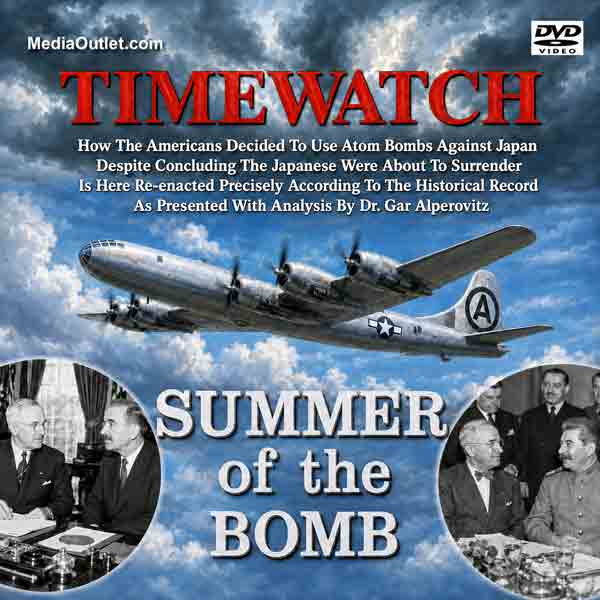
August 9: Nagasaki Day (Nagasaki Memorial
Day): -- August 9, 1945: World War II: The Pacific War (The
Asia-Pacific War, The Pacific Theater Of World War II): The
Asiatic-Pacific Theater: Aviation: Military Aviation: Air Warfare
Of World War II: Air Warfare Of The Pacific War: Air Raids On
Japan: Nuclear Weapons Programs Of The United States: The
Manhattan Project (Codename: Development Of Substitute Materials):
Nuclear Warfare: American Nuclear Warfare: Fat Man: Bockscar: The
Atomic Bombing Of Nagasaki: -- The second use of an Atomic bomb in
warfare occurs, dropped at 11:01 AM Japanese Time by the 393rd
Bombardment Squadron's Boeing B-29 Superfortress heavy bomber
Bockscar piloted by Major Charles W. Sweeney as part of "Special
Mission 16" onto the mission's secondary target, the Japanese
city of Nagasaki, after poor visibility caused them to abort the
bombing of the primary target, the Japanese city of Kokura. The
resulting explosion released the equivalent energy of
approximately 21 Kilotons. The bombing killed 35,000 people
outright, including 23,200-28,200 Japanese war workers, 2,000
Korean forced workers, and 150 Japanese soldiers, and killed an
estimated 70,000 persons in total in subsequent years from burns
and radiation poisoning. At 03:47 Tinian time (02:47 Japanese
time) that morning, Bockscar, flown by Sweeney's crew, lifted off
from North Field, Tinian, about six hours' flight time from Japan,
loaded with the Fat Man, with a mission plan nearly identical to
that of the Hiroshima mission, with two B-29s flying an hour ahead
as weather scouts (Enola Gay, which dropped the Hiroshima bomb,
piloted on this mission by Captain George W. Marquardt, and
Laggin' Dragon, piloted by Captain Charles F. McKnight) and two
additional B-29s in Sweeney's flight for instrumentation and
photographic support of the mission (The Great Artiste, carrying
blast measurement instrumentation as it had on the Hiroshima
mission [when it was piloted by this mission's Bockscar pilot
Major Sweeney], this time piloted by Captain Frederick C. Bock,
and Big Stink, carrying strike observation and photography
equipment, piloted by Major James I. Hopkins, Jr.). Sweeney took
off with Fat Man already armed, but with the electrical safety
plugs still engaged. When Sweeney's aircraft arrived at the
assembly point for his flight off the coast of Japan, Big Stink
failed to make the rendezvous, which was flying at varying heights
including 2,700 meters (9,000 ft) higher than he should have been,
and was not flying in tight circles over Yakushima, as previously
agreed. Though ordered not to circle longer than fifteen minutes,
Sweeney continued to wait for Big Stink for forty minutes, then
made the decision to proceed to Kokura, thirty minutes away,
accompanied by The Great Artiste. The delay resulted in clouds and
drifting smoke over Kokura from fires started by a major
firebombing raid by 224 B-29s on nearby Yahata the previous day.
Additionally, the Yahata Steel Works intentionally burned coal
tar, to produce black smoke. The clouds and smoke resulted in 70
percent of the area over Kokura being covered, obscuring the
aiming point. Three bomb runs were made over the next 50 minutes,
burning fuel and exposing the aircraft repeatedly to the heavy
defenses around Kokura, but the bombardier was unable to drop
visually. By the time of the third bomb run, Japanese
anti-aircraft fire was getting close, and Second Lieutenant Jacob
Beser, who was monitoring Japanese communications, reported
activity on the Japanese fighter direction radio bands. With fuel
running low, Bockscar and The Great Artiste headed for their
secondary target, Nagasaki. Fuel consumption calculations made en
route indicated that Bockscar had insufficient fuel to reach Iwo
Jima and would be forced to divert to Okinawa, which had become
entirely Allied-occupied territory only six weeks earlier. After
initially deciding that if Nagasaki were obscured on their arrival
the crew would carry the bomb to Okinawa and dispose of it in the
ocean if necessary, Ashworth agreed with Sweeney's suggestion that
a radar approach would be used if the target was obscured. At
about 07:50 Japanese time, an air raid alert was sounded in
Nagasaki, but the "all clear" signal was given at 08:30.
When only two B-29 Superfortresses were sighted at 10:53 Japanese
Time, the Japanese apparently assumed that the planes were only on
reconnaissance and no further alarm was given. A few minutes later
at 11:00 Japanese Time, The Great Artiste dropped instruments
attached to three parachutes. These instruments also contained an
unsigned letter to Professor Ryokichi Sagane, a physicist at the
University of Tokyo who studied with three of the scientists
responsible for the atomic bomb at the University of California,
Berkeley, urging him to tell the public about the danger involved
with these weapons of mass destruction. The messages were found by
military authorities but not turned over to Sagane until a month
later. In 1949, one of the authors of the letter, Luis Alvarez,
met with Sagane and signed the letter. At 11:01 Japanese Time, a
last-minute break in the clouds over Nagasaki allowed Bockscar's
bombardier, Captain Kermit Beahan, to visually sight the target as
ordered. The Fat Man weapon, containing a core of about 5 kg (11
lb) of plutonium, was dropped over the city's industrial valley.
It exploded 47 seconds later at approx. 1,650 ft above a tennis
court, halfway between the Mitsubishi Steel and Arms Works in the
south and the Nagasaki Arsenal in the north. This was nearly 3 km
(1.9 mi) northwest of the planned hypocenter; the blast was
confined to the Urakami Valley and a major portion of the city was
protected by the intervening hills. Big Stink spotted the
explosion from 160 kilometers (100 mi) away, and flew over to
observe. Bockscar flew on to Okinawa, arriving with only
sufficient fuel for a single approach. Sweeney tried repeatedly to
contact the control tower for landing clearance, but received no
answer. He could see heavy air traffic landing and taking off from
Yontan Airfield. Firing off every flare on board to alert the
field to his emergency landing, the Bockscar came in fast, landing
at 230 km/h (140 mph) instead of the normal 190 kilometers per
hour (120 mph). The number two engine died from fuel starvation as
he began the final approach. Touching down on only three engines
midway down the landing strip, Bockscar bounced up into the air
again for about 7.6 meters (25 ft) before slamming back down hard.
The heavy B-29 slewed left and towards a row of parked B-24
bombers before the pilots managed to regain control. Its
reversible propellers were insufficient to slow the aircraft
adequately, and with both pilots standing on the brakes, Bockscar
made a swerving 90-degree turn at the end of the runway to avoid
running off it. A second engine died from fuel exhaustion before
the plane came to a stop. Although the bomb was more powerful than
the one used on Hiroshima, its effects were confined by hillsides
to the narrow Urakami Valley. Of 7,500 Japanese employees who
worked inside the Mitsubishi Munitions plant, including
"mobilized" students and regular workers, 6,200 were
killed. Some 17,000-22,000 others who worked in other war plants
and factories in the city died as well. The 1946 Manhattan Project
report estimated 39,000 dead and 25,000 injured, and the 1951
U.S.-led Joint Commission report estimated 39,214 dead and 25,153
injured; Japanese-led reconsiderations in the 1970s estimated
70,000 dead in Nagasaki by the end of the year. A modern estimate
by the Radiation Effects Research Foundation (RERF) estimates a
city population of 250,000 to 270,000 at the time of the bombing,
of which 60,000 to 80,000 died by the end of the year. Unlike
Hiroshima's military death toll, only 150 Japanese soldiers were
killed instantly, including 36 from the 134th AAA Regiment of the
4th AAA Division. At least eight Allied prisoners of war (POWs)
died from the bombing, and as many as thirteen may have died. The
eight confirmed deaths included a British POW, Royal Air Force
Corporal Ronald Shaw, and seven Dutch POWs. One American POW, Joe
Kieyoomia, was in Nagasaki at the time of the bombing but
survived, reportedly having been shielded from the effects of the
bomb by the concrete walls of his cell. There were 24 Australian
POWs in Nagasaki, all of whom survived. The radius of total
destruction was about 1.6 km (1 mi), followed by fires across the
northern portion of the city to 3.2 km (2 mi) south of the bomb.
About 58 percent of the Mitsubishi Arms Plant was damaged, and
about 78 percent of the Mitsubishi Steel Works. The Mitsubishi
Electric Works suffered only 10 percent structural damage as it
was on the border of the main destruction zone. The Nagasaki
Arsenal was destroyed in the blast. Although many fires likewise
burnt following the bombing, in contrast to Hiroshima where
sufficient fuel density was available, no firestorm developed in
Nagasaki as the damaged areas did not furnish enough fuel to
generate the phenomenon. Instead, ambient wind pushed the fire
spread along the valley. Had the bomb been dropped more precisely
at the intended aiming point, which was downtown Nagasaki at the
heart of the historic district, the destruction to medical and
administrative infrastructure would have been even greater. As in
Hiroshima, the bombing badly dislocated the city's medical
facilities. A makeshift hospital was established at the Shinkozen
Primary School, which served as the main medical center. The
trains were still running, and evacuated many victims to hospitals
in nearby towns. A medical team from a naval hospital reached the
city in the evening, and fire-fighting brigades from the
neighboring towns assisted in fighting the fires. Takashi Nagai
was a doctor working in the radiology department of Nagasaki
Medical College Hospital. He received a serious injury that
severed his right temporal artery, but joined the rest of the
surviving medical staff in treating bombing victims. There were
plans for further attacks on Japan following Hiroshima and
Nagasaki. Manhattan Project chief General Leslie Groves expected
to have another "Fat Man" atomic bomb ready for use on
August 19, three more in September and a further three in October,
with a second Little Boy bomb available in December 1945. On
August 10, Groves sent a memorandum to Marshall in which he wrote
that "the next bomb ... should be ready for delivery on the
first suitable weather after 17 or 18 August." The memo today
contains hand-written comment written by Marshall: "It is not
to be released over Japan without express authority from the
President." At the cabinet meeting that morning, Truman
discussed these actions. James Forrestal paraphrased Truman as
saying "there will be further dropping of the atomic bomb,"
while Henry A. Wallace recorded in his diary that: "Truman
said he had given orders to stop atomic bombing. He said the
thought of wiping out another 100,000 people was too horrific. He
didn't like the idea of killing, as he said, 'all those kids.'"
The previous order that the target cities were to be attacked with
atomic bombs "as made ready" was thus modified. There
was already discussion in the War Department about conserving the
bombs then in production for Operation Downfall, the proposed
Allied plan for the invasion of the Japanese home islands, and
Marshall suggested to Stimson that the remaining cities on the
target list be spared attack with atomic bombs. Two more Fat Man
assemblies were readied, and scheduled to leave Kirtland Field for
Tinian on August 11 and 14, and Tibbets was ordered by LeMay to
return to Albuquerque, New Mexico, to collect them. At Los Alamos,
technicians worked 24 hours straight to cast another plutonium
core. Although cast, it still needed to be pressed and coated,
which would take until 16 August. Therefore, it could have been
ready for use on August 19. Unable to reach Marshall, Groves
ordered on his own authority on August 13 that the core should not
be shipped. Until the Nagasaki bombing, Japan's war council still
insisted on its four conditions for surrender: 1) the retention of
the Emperor, 2) Japan would disarm her own forces, 3) Japan would
conduct its own war crimes trials of her own nationals by itself,
and 4) there would be no occupation of Japan. When the full
cabinet met at 14:30 that afternoon, it spent most its time
debating surrender. Minister Of War Korechika Anami conceded that
victory was unlikely, but argued in favor of continuing the war.
The meeting ended at 17:30, with no decision having been reached.
Prime Minister Kantaro Suzuki went to the palace to report on the
outcome of the meeting, where he met with Koichi Kido, the Lord
Keeper of the Privy Seal of Japan. Kido informed him that the
emperor had agreed to hold an imperial conference, and gave a
strong indication that the emperor would consent to surrender on
condition that kokutai (national sovereignty) be preserved. A
second cabinet meeting was held at 18:00. Only four ministers
supported Anami's position of adhering to the four conditions, but
since cabinet decisions had to be unanimous, no decision was
reached before it ended at 22:00. Calling an imperial conference
required the signatures of the prime minister and the two service
chiefs, but the Chief Cabinet Secretary Hisatsune Sakomizu had
already obtained signatures from Toyoda and General Yoshijiro
Umezu in advance, and he reneged on his promise to inform them if
a meeting was to be held. The meeting commenced at 23:50. No
consensus had emerged by 02:00 on August 10, but then the emperor
gave his "sacred decision", authorizing the Foreign
Minister, Shigenori Togo, to notify the Allies that Japan would
accept their terms on one condition, that the declaration "does
not comprise any demand which prejudices the prerogatives of His
Majesty as a Sovereign ruler." On August 12, the Emperor
informed the imperial family of his decision to surrender. One of
his uncles, Prince Asaka, asked whether the war would be continued
if the kokutai could not be preserved. Hirohito simply replied,
"Of course." As the Allied terms seemed to leave intact
the principle of the preservation of the Throne, Hirohito recorded
on August 14 his capitulation announcement which was broadcast to
the Japanese nation the next day despite an attempted military
coup d'etat by militarists opposed to the surrender. In his
declaration's fifth paragraph, Hirohito solely mentions the
duration of the conflict; and did not explicitly mention the
Soviets as a factor for surrender: "But now the war has
lasted for nearly four years. Despite the best that has been done
by every one -- the gallant fighting of military and naval forces,
the diligence and assiduity of Our servants of the State and the
devoted service of Our one hundred million people -- the war
situation has developed not necessarily to Japan's advantage,
while the general trends of the world have all turned against her
interest." The sixth paragraph by Hirohito specifically
mentions the use of nuclear ordnance devices, from the aspect of
the unprecedented damage they caused: "Moreover, the enemy
has begun to employ a new and most cruel bomb, the power of which
to do damage is, indeed, incalculable, taking the toll of many
innocent lives. Should we continue to fight, not only would it
result in an ultimate collapse and obliteration of the Japanese
nation, but also it would lead to the total extinction of human
civilization." The seventh paragraph gives the reason for the
ending of hostilities against the Allies: "Such being the
case, how are we to save the millions of our subjects, or to atone
ourselves before the hallowed spirits of our imperial ancestors?
This is the reason why we have ordered the acceptance of the
provisions of the joint declaration of the powers." While
Hirohito did not mention the Soviet invasion of Japan in his
broadcast to his people, in his "Rescript to the Soldiers and
Sailors" delivered on August 17, Hirohito did not refer
either to the atomic bombs or possible human extinction, bur
rather instead described the Soviet declaration of war as
"endangering the very foundation of the Empire's existence."
On Sale @ 15% Off Discount Till Midnight PT!
https://store.earthstation1.com/summer-of-the-bomb-dvd-why-us-nuked-japan.html
Today's
EarthStation1.com 15% (Or More!) Off Commemorative Memorial Title:
World War II: The War Years 17 Part TV Series MP4 Video Download
DVD
Today, August 9, 2026
August 9, 1945: World War II: The Pacific
War (The Asia-Pacific War, The Pacific Theater Of World War II):
China: The History Of China: The Century Of Humiliation (The
Hundred Years Of National Humiliation) (1838-1945): The
Sino-Japanese Wars: The Second Sino-Japanese War (The War Of
Resistance Against Japanese Aggression): The Soviet-Japanese War
(August 8 - September 2, 1945): The Soviet Invasion Of Manchuria
(The Manchurian Strategic Offensive Operation, The Manchurian
Operation (Russian: Man'chzhurskaya Operatsiya): -- The Red Army
invades Japanese-occupied Manchuria. At 11 pm Trans-Baikal time on
August 8, 1945, Soviet foreign minister Molotov informed Japanese
ambassador Sato that the Soviet Union had declared war on Japan,
and that from August 9 the Soviet Government would consider itself
to be at war with Japan. At one minute past midnight Trans-Baikal
time on August 9, 1945, the Soviets commenced the Manchurian
Strategic Offensive Operation (a name that refers more to the
Soviet Invasion Of Manchuria than to the whole war), with
invasions occurring simultaneously on three fronts to the east,
west and north of Manchuria. Though the battle extended beyond the
borders traditionally known as Manchuria - that is, the
traditional lands of the Manchus - the coordinated and integrated
invasions of Japan's northern territories has also been called the
Battle of Manchuria. Since 1983, the operation has sometimes been
called Operation August Storm, after American Army historian
Lieutenant-Colonel David Glantz used this title for a paper on the
subject. The operation was subdivided into smaller operational and
tactical parts: 1) Khingan-Mukden Offensive Operation (August 9,
1945 - September 2, 1945); 2) Harbin-Kirin Offensive Operation
(August 9, 1945 - September 2, 1945); 3) Sungari Offensive
Operation (August 9, 1945 - September 2, 1945); and subsequently
4) South Sakhalin Operation (August 11, 1945 - August 25, 1945),
also known as The Invasion of South Sakhalin and The Battle of
Sakhalin, consisting of a) the Soviet assault on Maoka, and b) the
Soviet assault on Toro; 5) Seisin Landing Operation (August 13,
1945 - August 16, 1945); and 6) Kuril Landing Operation (August
18, 1945 - September 1, 1945). On Sale @ 15% Off Discount Till
Midnight PT!
https://store.earthstation1.com/world-war-ii-the-war-years-17-part-tv-series-mp4-video-download-174.html
Today's
EarthStation1.com 15% (Or More!) Off Commemorative Memorial Title:
France: Conquest To Liberation In World War II MP4 Video Download
DVD
Today, August 9, 2026
August 9, 1944: The European Civil War:
World War II: The Second European War (The European Theater Of
World War II): Vichy France (The French State): The Government Of
Vichy France (July 10, 1940 - August 9, 1944): The Liberation Of
France: The Aftermath Of World War II: The Ordinance Of 9 August
1944: -- The Government Of Vichy effectively ends with The
Ordinance Of 9 August 1944, a constitutional law enacted by The
Provisional Government Of The French Republic (GPRF), which
re-establishes republican rule of law in mainland France after
four years of occupation by Nazi Germany and control by the
collaborationist Vichy regime. The Provisional Government Of The
French Republic (PGFR; French: Gouvernement Provisoire De La
Republique Francaise [GPRF]), the provisional government of Free
France beginning on June 3, 1944, assumed control of France and
continued to rule until its own disestablishment with the founding
of The French Fourth Republic on October 27, 1946. The Vichy
Government had been established on July 10, 1940 when a set of
bills known as The French Constitutional Law Of 1940 were voted
into law by the National Assembly, which comprised both the Senate
and the Chamber of Deputies during the French Third Republic. The
law established the Vichy regime and passed with 569 votes to 80,
with 20 abstentions. The group of 80 parliamentarians who voted
against it are known as the Vichy 80. The law gave all the
government powers to Philippe Petain, and further authorized him
to take all necessary measures to write a new constitution. Petain
interpreted this as de facto suspending the French Constitutional
Laws of 1875 which established the Third Republic, even though the
law did not explicitly suspend it, but only granted him the power
to write a new constitution. The next day, by Act No 2, Petain
defined his powers and abrogated all the laws of the Third
Republic that were incompatible with them. Although given full
constituent powers by the law, Petain never promulgated a new
constitution. A draft was written in 1941 and signed by Petain in
1944, but it was never submitted or ratified. The Government Of
Vichy France effectively ended with The Ordinance of 9 August
1944, an ordinance promulgated by the Provisional Government of
the French Republic after D-Day, asserting the nullity of the
Constitutional Law of 1940 and other classes of law passed later
by Vichy. The Constitution of 1940 was not repealed or annulled
but rather declared void ab initio (Latin: "void from the
beginning"), having no legal effect. The Ordinance of 9
August 1944 was a constitutional law enacted by The Provisional
Government Of The French Republic (GPRF) which re-established
republican rule of law in mainland France after four years of
occupation by Nazi Germany and control by the collaborationist
Vichy regime. On Sale @ 15% Off Discount Till Midnight PT!
https://store.earthstation1.com/france-conquest-to-liberation-occupied-and-vichy-wwii.html
Today's
EarthStation1.com 15% (Or More!) Off Commemorative Memorial Title:
Julius Caesar The Battle Of Alesia, His Assassination MP4 Download
DVD
Today, August 9, 2026
August 9, 48 BC: Rome: Ancient Rome:
Roman Civil Wars: The Roman Republic: The Crisis Of The Roman
Republic: Caesar's Civil War (The Great Roman Civil War): The
Battle Of Pharsalus: -- In a historical turning point that raised
Julius Caesar to the pinnacle of power and brought about the
effective end of the Roman Republic, Julius Caesar wins the
decisive battle of Caesar's Civil War when he and his
significantly outnumbered veteran Caesarian legions and allies,
formed up opposite Pompey's loyal army backed of a majority of
Roman senators, decisively defeats Pompey at Pharsalus in Central
Greece, forcing Pompey to flee in retreat to Egypt. Pressured by
his officers, Pompey reluctantly engaged in battle and suffered an
overwhelming defeat, ultimately fleeing the camp and his men,
disguised as an ordinary citizen. Eventually making his way to
Egypt, he was assassinated upon his arrival at the order of
Ptolemy XIII. Caesar's Civil War (49-45 BC) was a civil war during
the late Roman Republic between Gaius Julius Caesar and Gnaeus
Pompeius Magnus. The main cause of the war was political tensions
relating to Caesar's place in the republic on his expected return
to Rome on the expiration of his governorship in Gaul. Before the
war, Caesar had led an invasion of Gaul for almost ten years. A
build-up of tensions starting in late 50 BC, with both Caesar and
Pompey refusing to back down, led to the outbreak of civil war.
Pompey and his allies induced the Senate to demand Caesar give up
his provinces and armies in the opening days of 49 BC. Caesar
refused and instead marched on Rome. The war was fought in Italy,
Illyria, Greece, Egypt, Africa, and Hispania. Pompey defeated
Caesar in 48 BC at the Battle of Dyrrhachium, but was himself
defeated decisively at the Battle of Pharsalus. Many former
Pompeians, including Marcus Junius Brutus and Cicero, surrendered
after the battle, while others, such as Cato the Younger and
Metellus Scipio fought on. Pompey fled to Egypt, where he was
assassinated on arrival. Caesar intervened in Africa and Asia
Minor before attacking North Africa, where he defeated Scipio in
46 BC at the Battle of Thapsus. Scipio and Cato committed suicide
shortly thereafter. The following year, Caesar defeated the last
of the Pompeians under his former lieutenant Labienus in the
Battle of Munda. He was made dictator perpetuo ("dictator in
perpetuity" or "dictator for life") in 44 BC and
assassinated shortly thereafter. The civil war is commonly
recognised as one of the possible endpoints of Rome's republican
government. Its outbreak also has been seen by some Romanists as
the proximate cause of the republic's fall due to its polarising
interruption of normal republican government. Caesar's victory and
the following total victory of his heir some twenty years after
his death led to the formation of the Roman Empire. On Sale Until
Midnight Tonight PT!
https://store.earthstation1.com/julius-caesar-and-the-battle-of-alesia-dvd-mp4-usb-driv4.html
Today's
EarthStation1.com 15% (Or More!) Off Commemorative Memorial Title:
The Final Days: Richard Nixon TV Docudrama DVD, Download, USB
Drive
Today, August 9, 2026
August 9, 1974: Scandals: Political
Scandals: Political Scandals Of The United States: Richard Nixon:
The Presidency Of Richard Nixon: The Watergate Scandal: The
Presidential Resignation Of Richard Nixon: -- Effective at noon,
Richard M. Nixon resigns the presidency as a result of the
Watergate Scandal. The evening prior, Richard Nixon's Resignation
Speech was delivered in an Oval Office address made nationwide on
television and radio, announcing to the American public his
resignation from the office of the President of the United States
effective noon the next day. The purpose of the speech was for
Nixon, who had been intimately involved in the events surrounding
the Watergate scandal that occurred during his controversial
re-election campaign in 1972, to announce to the nation that he
was resigning from office. Watergate had cost Nixon much of his
political support, and at the time of his resignation, he faced
almost certain impeachment and removal from office. Nixon was the
ninth incumbent president not to complete the four-year term to
which they had been elected since the presidency was established
in 1789. He was however, the first to do so for a reason other
than dying in office. His presidential resignation remains the
only one in U.S. history. On Sale @ 15% Off Discount Till Midnight
PT!
https://store.earthstation1.com/the-final-days-dvd-1989-pres-nixon-resignation-docudrama-2-dis19892.html
Today's
EarthStation1.com 15% (Or More!) Off Commemorative Memorial Title:
Battleline (1963) WWII TV Documentary Series DVD, Download, USB
Drive
Today, August 9, 2026
August 9/10, 1942: The European Civil
War: World War II: The Second European War (The European Theater
Of World War II): The Mediterranean And Middle East Theater Of
World War II: The Battle Of The Mediterranean: The Siege Of Malta
(World War II): Operation Pedestal (Italian: Battaglia di Mezzo
Agosto, "Battle Of Mid-August", Maltese: Il-Konvoj Ta'
Santa Marija, "The Convoy Of Santa Maria"): -- One of
the fiercest and most heavily contested of the Malta convoys known
as Operation Pedestal passes through the Straits of Gilbraltar
during the night and is immediately and heavily attacked by
bombers, German E-boats, Italian MAS and MS boats, minefields and
submarine ambushes in the last sizeable Axis success in the
Mediterranean. More than 500 Merchant and Royal Navy sailors and
airmen were killed and only five of the 14 merchant ships reached
Grand Harbour. While costly for the Allies, it was a strategic
victory; the arrival of SS Ohio and her cargo of aviation fuel
revitalised the Maltese air offensive against Axis shipping, and
effectively saved the island from the Axis. justified the decision
to hazard so many warships. The Operation Pedestal convoy had set
sail from Britain on August 3, 1942. The SS Ohio, an American oil
tanker built for the Texas Oil Company (now Texaco) manned by a
British crew, reached Malta on August 15, 1942 barely afloat and
carrying vital kerosene and diesel aviation fuel oil supplies for
the island's defenses. Because of SS Ohio's replenishment of
Malta's fuel stocks, submarines returned to Malta and Supermarine
Spitfires flown from the aircraft carrier HMS Furious enabled a
maximum effort to be made against Axis ships. Italian convoys had
to detour further away from the island, lengthening the journey
and increasing the time during which air and naval attacks could
be mounted. The Siege of Malta was broken by the Allied
re-conquest of Egypt and Libya after the Second Battle Of El
Alamein (October 23 - November 11) and by Operation Torch
(November 8-16) in the western Mediterranean, which enabled
land-based aircraft to escort merchant ships to the island.
Although the SS Ohio reached Malta successfully, she was so badly
damaged that she had to be effectively scuttled in order to
offload her cargo; the ship broke in two from the damage she had
sustained, and as there were insufficient shipyard facilities to
repair the tanker, the two halves were used for storage, and later
barracks facilities for Yugoslavian troops. On September 19, 1946
the forward half of Ohio was towed ten miles offshore and sunk by
gunfire from the destroyer HMS Virago. On October 3, the stern
half was scuttled in deep water using explosive charges laid by
the salvage vessel RFA Salventure. The tanker is fondly remembered
in Malta, where to this day she is considered to be the savior of
the beleaguered island. The Siege of Malta in World War II was a
military campaign in the Mediterranean Theatre. From June 1940 to
November 1942, the fight for the control of the strategically
important island of the British Crown Colony of Malta, which
pitted the air forces and navies of Fascist Italy and Nazi Germany
against the Royal Air Force (RAF) and the Royal Navy. Operation
Pedestal (Italian: Battaglia Di Mezzo Agosto, "Battle Of
Mid-August"; Maltese: Il-Konvoj Ta' Santa Marija, "The
Convoy of St. Mary"), was a British naval convoy operation to
carry supplies to the island of Malta in August 1942. Malta was a
base from which British ships, submarines and aircraft attacked
Axis convoys to Libya, during the North African Campaign
(1940-1943). From 1940 to 1942, the Axis conducted the Siege of
Malta, with air and naval forces. Despite many losses, enough
supplies were delivered by the British for the population and
military forces on Malta to resist, although it ceased to be an
offensive base for much of 1942. On Sale Until Midnight Tonight
PT!
https://store.earthstation1.com/battleline-wwii-tv-documentary-series-5-dual-layer-dvd5.html
Today's
EarthStation1.com 15% (Or More!) Off Commemorative Memorial Title:
The Guns Of August (1964) WWI Film DVD, Video Download, USB Drive
Today, August 9, 2026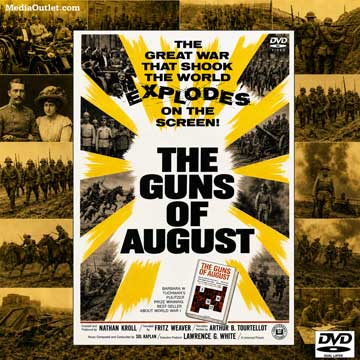
August 9, 1914: The European Civil War:
World War I: The First European War (The European Theater Of World
War I): The Guns Of August: The Western Front Of World War I: The
Battle Of The Frontiers: The Battle Of Mulhouse (The Battle Of
Alsace): -- Parts of the XIV and XV Corps of the German 7th Army
arrive from Strasbourg in the early morning and counter-attacked
at Cernay, 17 km northwest of Mulhouse on the Thur River, against
the French Forces who had mobilized to occupy Mulhouse on August 7
(and succeeded in occupying on August 8) as part of the first
French offensive of World War I, a French attempt to recover the
province of Alsace, beginning the first combat operations of the
First World War. The French were forced out of Mulhouse by the
German 7th Army counter-attacks on August 10, 1914. The Battle Of
Mulhouse, also called the Battle of Alsace, which began on August
7, 1914, was the opening attack of World War I by the French Army
against Germany. The battle was part of a French attempt to
recover the province of Alsace, which France had ceded to the new
German Empire following defeat in the Franco-Prussian War of
1870-1871. On Sale Until Midnight Tonight PT!
https://store.earthstation1.com/the-guns-of-august-dvd-1964-world-war-i-movie-documen1964.html
Today's
EarthStation1.com 15% (Or More!) Off Commemorative Memorial Title:
The Gulf Crisis: The Road To War TV Series + Bonus 2 DVDs MP4
Download
Today, August 9, 2026
August 9, 1990: The Aftermath Of World
War II: The Cold War: The Gulf War (The Persian Gulf War, Gulf War
I): The Invasion Of Kuwait: United Nations Security Council
Resolution 662 (UNSCR662): -- United Nations Security Council
Resolution 662 (UNSCR 662) is adopted unanimously, declaring the
annexation of Kuwait by Iraq illegal in any form, reaffirming
Resolutions 660, which condemned the invasion and demanded Iraq
withdraw immediately and unconditionally to positions as they were
on August 1. 1990, and 661, which itself reaffirmed Resolution 660
implemented international sanctions on Iraq under Chapter VII of
the United Nations Charter. The Council called upon all States and
international organisations not to recognise the annexation,
further asking States to refrain from any action that may
constitute an indirect recognition of the annexation. It also
demanded Iraq rescind its actions in Kuwait after the invasion,
keeping the situation on its agenda. On Sale Until Midnight
Tonight PT!
https://store.earthstation1.com/the-gulf-crisis-the-road-to-war-tv-documentary-series-dvd-mp4-us4.html
Today's
EarthStation1.com 15% (Or More!) Off Commemorative Memorial Title:
Saddam Hussein: His Life, His Regime, His Iraq DVD, Download, USB
Today, August 9, 2026
August 9, 1990: The Aftermath Of World
War II: The Cold War: The Gulf War (The Persian Gulf War, Gulf War
I): The Invasion Of Kuwait: Operation Desert Shield: -- In
response to the American military buildup in Saudi Arabia and to
international pressure against Iraq's invasion and annexation of
Kuwait, Iraq closes all its land borders. The day prior, Operation
Desert Shield had been officially launched, as the day before that
President George Bush ordered a massive military buildup to
prevent further Iraqi military advances, with the first American
soldiers being sent to Saudi Arabia that same day: 15,000 U.S.
troops, 32 destroyers and 100 helicopters and fighter planes. Soon
after his conquest of Kuwait, Saddam began verbally attacking the
Saudis. He argued that the US-supported Saudi state was an
illegitimate and unworthy guardian of the holy cities of Mecca and
Medina. He combined the language of the Islamist groups that had
recently fought in Afghanistan with the rhetoric Iran had long
used to attack the Saudis. Acting on the Carter Doctrine's policy
that the United States would use military force, if necessary, to
defend its national interests in the Persian Gulf, and out of fear
the Iraqi Army could launch an invasion of Saudi Arabia, US
President George Bush quickly announced that the US would launch a
"wholly defensive" mission to prevent Iraq from invading
Saudi Arabia under the codename Operation Desert Shield. Operation
Desert Shield began on 7 August 1990 when US troops were sent to
Saudi Arabia due also to the request of its monarch, King Fahd,
who had earlier called for US military assistance. This "wholly
defensive" doctrine was quickly abandoned when, on 8 August,
Iraq declared Kuwait to be Iraq's 19th province and Saddam named
his cousin, Ali Hassan Al-Majid, as its military-governor. The US
Navy dispatched two naval battle groups built around the aircraft
carriers USS Dwight D. Eisenhower and USS Independence to the
Persian Gulf, where they were ready by 8 August. The US also sent
the battleships USS Missouri and USS Wisconsin to the region. A
total of 48 US Air Force F-15s from the 1st Fighter Wing at
Langley Air Force Base, Virginia, landed in Saudi Arabia, and
immediately commenced round the clock air patrols of the
Saudi-Kuwait-Iraq border to discourage further Iraqi military
advances. They were joined by 36 F-15 A-Ds from the 36th Tactical
Fighter Wing at Bitburg, Germany. The Bitburg contingent was based
at Al Kharj Air Base, approximately an hour south east of Riyadh.
The 36th TFW would be responsible for 11 confirmed Iraqi Air Force
aircraft shot down during the war. There were also two Air
National Guard units stationed at Al Kharj Air Base, the South
Carolina Air National Guard's 169th Fighter Wing flew bombing
missions with 24 F-16s flying 2,000 combat missions and dropping 4
million pounds of munitions, and the New York Air National Guard's
174th Fighter Wing from Syracuse flew 24 F-16s on bombing
missions. Military buildup continued from there, eventually
reaching 543,000 troops, twice the number used in the 2003
invasion of Iraq. Much of the material was airlifted or carried to
the staging areas via fast sealift ships, allowing a quick
buildup. On Sale Until Midnight Tonight PT!
https://store.earthstation1.com/saddam-hussein-his-life--his-regime--his-iraq-dvd-3-disc3.html
Today's
EarthStation1.com 15% (Or More!) Off Commemorative Memorial Title:
Charles Manson: A Documentary History DVD, MP4 Download, USB Drive
Today, August 9, 2026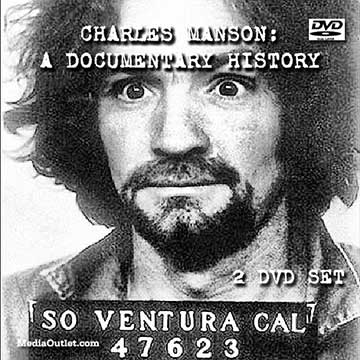
August 8-10, 1969: Crime: Crime In The
United States: Charles Manson: The Manson Family (The Family):
Charles Manson And The Manson Family: The Helter Skelter Scenario:
The Manson Family Murders: The Tate-LaBianca Murders: -- #DOTD:
#RIP: On August 8-9, 1969, followers led by Charles Manson murder
pregnant actress Sharon Tate (wife of Roman Polanski), coffee
heiress Abigail Folger, Polish actor Wojciech Frykowski, men's
hairstylist Jay Sebring and recent high-school graduate Steven
Parent. The day after those murders, August 9-10, 1969, members of
Manson's cult killed Leno and Rosemary LaBianca. Charles Manson
went on trial for these murders on June 15, 1970. Charles Milles
Manson (born Charles Milles Maddox, November 12, 1934 - November
19, 2017) was an American convicted mass murderer and former cult
leader who led what became known as the Manson Family, a
quasi-commune that arose in California in the late 1960s. Manson's
followers committed a series of nine murders at four locations in
July and August 1969. In 1971 he was found guilty of first-degree
murder and conspiracy to commit murder for the deaths of seven
people: most notably of the actress Sharon Tate: all of which were
carried out by members of the group at his instruction. Manson
also received first-degree murder convictions for two other
deaths. Manson was originally sentenced to death, but his sentence
was commuted to life imprisonment when California invalidated the
state's death penalty statute in 1972. He is currently serving
multiple life sentences at California State Prison in Corcoran.
Manson believed in what he called "Helter Skelter", a
term he took from the Beatles song of the same name. Manson
believed Helter Skelter to be an impending apocalyptic race war,
which he described in his own version of the lyrics to the Beatles
song. He believed the murders would help precipitate that war.
From the beginning of his notoriety, a pop culture arose around
him in which he ultimately became an emblem of insanity, violence
and the macabre. At the time the Family began to form, Manson was
an unemployed former convict, who had spent half of his life in
correctional institutions for a variety of offenses. Before the
murders, he was a singer-songwriter on the fringe of the Los
Angeles music industry, chiefly through a chance association with
Dennis Wilson, drummer and founding member of the Beach Boys.
After Manson was charged with the crimes of which he was later
convicted, recordings of songs written and performed by him were
released commercially. Various musicians have covered some of his
songs, including Guns N' Roses, Marilyn Manson, Crispin Glover and
GG Allin. On Sale Until Midnight Tonight PT!
https://store.earthstation1.com/charles-manson-a-documentary-history-dvd-mp4-download-usb-driv4.html
Today's
EarthStation1.com 15% (Or More!) Off Commemorative Memorial Title:
Eye Of The Dictator: Nazi Newereels Feature Documentary DVD, MP4,
USB
Today, August 9, 2026
August 9, 1936: The Olympic Games (The
Olympics): The 1936 Summer Olympics: (German: Olympische
Sommerspiele 1936)) (The Games Of The XI Olympiad (German: Spiele
Der XI. Olympiade), Berlin 1936): -- Jesse Owens wins his fourth
of four gold medals at the Berlin Olympic Games in the 4 x 100 m
sprint relay when head coach Lawson Robertson replaced
Jewish-American sprinters Marty Glickman and Sam Stoller with
Owens and Ralph Metcalfe, who teamed with Frank Wykoff and Foy
Draper to set a world record of 39.8 seconds in the event. Owens
had initially protested the last-minute switch, but assistant
coach Dean Cromwell said to him, "You'll do as you are told."
Owens' record-breaking performance of four gold medals was not
equaled until Carl Lewis won gold medals in the same events at the
1984 Summer Olympics in Los Angeles. Owens participation in the
1936 Berlin Olympic Games was controversial on a number of
accounts. On December 4, 1935, NAACP Secretary Walter Francis
White wrote a letter to Owens about the matter, but never sent it.
In it, he tryied to dissuade Owens from taking part in the
Olympics in Nazi Germany, arguing that an African American should
not promote a racist regime after what his race had suffered at
the hands of white racists in his own country. In the months prior
to the Games, a movement gained momentum in favor of a boycott.
Owens was convinced by the NAACP to declare: "If there are
minorities in Germany who are being discriminated against, the
United States should withdraw from the 1936 Olympics". Yet he
and others eventually took part after Avery Brundage, president of
the American Olympic Committee branded them "un-American
agitators". In 1936, Owens and his United States teammates
sailed to the games on the SS Manhattan. Owens arrived at the new
Olympic stadium to a throng of fans, many of them young girls
yelling "Wo ist Jesse? Wo ist Jesse?" ("Where is
Jesse? Where is Jesse?"). Just before the competitions,
founder of Adidas athletic shoe company Adi Dassler visited Owens
in the Olympic village and persuaded Owens to wear Gebruder
Dassler Schuhfabrik shoes; this was the first sponsorship for a
male African American athlete. Hitler was subsequently accused of
failing to acknowledge Owens (who won gold medals on August 3, 4
(two), and 9) or shake his hand. Owens responded to these claims
at the time: "Hitler had a certain time to come to the
stadium and a certain time to leave. It happened he had to leave
before the victory ceremony after the 100 meters [race began at
5:45 p.m.. But before he left I was on my way to a broadcast and
passed near his box. He waved at me and I waved back. I think it
was bad taste to criticize the "man of the hour" in
another country." In an article dated August 4, 1936, the
African American newspaper editor Robert L. Vann describes
witnessing Hitler "salute" Owens for having won gold in
the 100m sprint of August 3: "And then;_ wonder of wonders;_
I saw Herr Adolph Hitler, salute this lad. I looked on with a
heart which beat proudly as the lad who was crowned king of the
100 meters event, get an ovation the like of which I have never
heard before. I saw Jesse Owens greeted by the Grand Chancellor of
this country as a brilliant sun peeped out through the clouds. I
saw a vast crowd of some 85,000 or 90,000 people stand up and
cheer him to the echo." Despite these accounts, Owens's
successes at the games caused consternation for Hitler, who was
using them to show the world a resurgent Nazi Germany. He and
other government officials had hoped that German athletes would
dominate the games. Nazi minister Albert Speer wrote that Hitler
"was highly annoyed by the series of triumphs by the
marvelous colored American runner, Jesse Owens. People whose
antecedents came from the jungle were primitive, Hitler said with
a shrug; their physiques were stronger than those of civilized
whites and hence should be excluded from future games." In
2014, Eric Brown, British fighter pilot and test pilot, the Fleet
Air Arm's most decorated living pilot, stated in the BBC
documentary "Britain's Greatest Pilot: The Extraordinary
Story Of Captain Winkle Brown": "I actually witnessed
Hitler shaking hands with Jesse Owens and congratulating him on
what he had achieved". Additionally, an article in The
Baltimore Sun in August 1936 reported that Hitler sent Owens a
commemorative inscribed cabinet photograph of himself. Later, on
October 15, 1936, Owens repeated this allegation when he addressed
an audience of African Americans at a Republican rally in Kansas
City, remarking: "Hitler didn't snub me - it was our
president who snubbed me. The president didn't even send me a
telegram." In Germany, Owens had been allowed to travel with
and stay in the same hotels as whites, at a time when African
Americans in many parts of the United States, chiefly in the
South, had to stay in segregated hotels that accommodated only
blacks. When Owens returned to the United States, he was greeted
in New York City by Mayor Fiorello LaGuardia. During a Manhattan
ticker-tape parade in his honor along Broadway's Canyon of Heroes,
someone handed Owens a paper bag. Owens paid it little mind until
the parade concluded. When he opened it up, he found that the bag
contained 10K USD in cash. Owens's wife Ruth later said: "And
he [Owens] didn't know who was good enough to do a thing like
that. And with all the excitement around, he didn't pick it up
right away. He didn't pick it up until he got ready to get out of
the car". After the parade, Owens was not permitted to enter
through the main doors of the Waldorf Astoria New York and instead
forced to travel up to the reception honoring him in a freight
elevator. President Franklin D. Roosevelt (FDR) never invited
Jesse Owens to the White House following his triumphs at the
Olympic Games. When the Democrats bid for his support, Owens
rejected those overtures: as a staunch Republican, he endorsed Alf
Landon, Roosevelt's Republican opponent in the 1936 presidential
race. Owens joined the Republican Party after returning from
Europe and was paid to campaign for African American votes for the
Republican presidential nominee Alf Landon in the 1936
presidential election. Speaking at a Republican rally held in
Baltimore on October 9, 1936, Owens said: "Some people say
Hitler snubbed me. But I tell you, Hitler did not snub me. I am
not knocking the President. Remember, I am not a politician, but
remember that the President did not send me a message of
congratulations because, people said, he was too busy." Jesse
Owens, African American track and field athlete and four-time
Olympic gold medalist in the 1936 Games (d. 1980) is born James
Cleveland Owens on September 12, 1913. He specialized in the
sprints and the long jump, and was recognized in his lifetime as
"perhaps the greatest and most famous athlete in track and
field history". He set three world records and tied another,
all in less than an hour at the 1935 Big Ten track meet in Ann
Arbor, Michigan-a feat that has never been equaled and has been
called "the greatest 45 minutes ever in sport". He
achieved international fame at the 1936 Summer Olympics in Berlin,
Germany by winning four gold medals: 100 meters, 200 meters, long
jump, and 4 _ 100 meter relay. He was the most successful athlete
at the Games and, as a black man, was credited with
"single-handedly crushing Hitler's myth of Aryan supremacy",
although he "wasn't invited to the White House to shake hands
with the President, either". The Jesse Owens Award is USA
Track and Field's highest accolade for the year's best track and
field athlete. Owens was ranked by ESPN as the sixth greatest
North American athlete of the 20th century and the highest-ranked
in his sport. In 1999, he was on the six-man short-list for the
BBC's Sports Personality of the Century. On Sale Until Midnight
Tonight PT!
https://store.earthstation1.com/eye-of-the-dictator-dvd-third-reich-propaganda-films.html
Today's
EarthStation1.com 15% (Or More!) Off Commemorative Memorial Title:
The Machine That Changed The World: The Computer DVD MP4 Download
Today, August 9, 2026
August 9, 1927: #BOTD: #HBD! Marvin
Minsky, American cognitive and computer scientist and academic,
concerned largely with research of artificial intelligence (AI),
co-founder of the Massachusetts Institute of Technology's AI
laboratory, and author of several texts concerning AI and
philosophy (d. January 24, 2016) is #born Marvin Lee Minsky in New
York City into the Jewish family of eye surgeon father Henry and
Zionist activist mother, Fannie (Reiser) Minsky. Marvin Minsky
received many accolades and honors, including the 1969 Turing
Award. Marvin Minsky died of a cerebral hemorrhage in Boston,
Massachusetts, aged 88. Minsky was a member of Alcor Life
Extension Foundation's Scientific Advisory Board, which advocates
for, researches, and performs cryonics, the freezing of human
corpses and brains in liquid nitrogen after legal death, with
hopes of resurrecting and restoring them to full health if the
technology to do so becomes available in the future. Alcor will
neither confirm nor deny whether Minsky was cryonically preserved.
On Sale Until Midnight Tonight PT!
https://store.earthstation1.com/the-machine-that-changed-the-world-the-computer-dvd-mp4-downloa4.html
Today's
EarthStation1.com 15% (Or More!) Off Commemorative Memorial Title:
The Battle Of Guadalcanal DVD MP4 Download USB Flash Drive
Today, August 9, 2026
August 9, 1942: World War II: The Pacific
War (The Asia-Pacific War, The Pacific Theater Of World War II):
The Pacific Ocean Theater Of World War II: Operation Cartwheel:
The Solomon Islands Campaign: The Battle Of Guadalcanal (The
Guadalcanal Campaign, Operation Watchtower): The Battle Of Savo
Island (The First Battle Of Savo Island, The First Battle Of The
Solomon Sea [Japanese: Dai-ichi-Ji Soromon Kaisen], The Battle Of
The Five Sitting Ducks): -- Allied naval forces protecting their
amphibious forces during the initial stages of the Battle Of
Guadalcanal are surprised and defeated by an Imperial Japanese
Navy cruiser force. The Battle Of Savo Island, also known as the
First Battle Of Savo Island and, in Japanese sources, as the First
Battle of the Solomon Sea, and colloquially among Allied
Guadalcanal veterans as The Battle of the Five Sitting Ducks, was
a naval battle of the Pacific Campaign of World War II between the
Imperial Japanese Navy and Allied naval forces. The battle took
place on August 8-9, 1942 and was the first major naval engagement
of the Guadalcanal campaign, and the first of several naval
battles in the straits later named Ironbottom Sound, near the
island of Guadalcanal. The Imperial Japanese Navy, in response to
Allied amphibious landings in the eastern Solomon Islands,
mobilized a task force of seven cruisers and one destroyer under
the command of Vice Admiral Gunichi Mikawa. The task forces sailed
from Japanese bases in New Britain and New Ireland down New
Georgia Sound (also known as "the Slot"), with the
intention of interrupting the Allied landings by attacking the
supporting amphibious fleet and its screening force. The Allied
screen consisted of eight cruisers and fifteen destroyers under
British Rear Admiral Victor Crutchley VC, but only five cruisers
and seven destroyers were involved in the battle. In a night
action, Mikawa thoroughly surprised and routed the Allied force,
sinking one Australian and three American cruisers, while
suffering only light damage in return. The battle has often been
cited as the worst defeat in a fair fight in the history of the
United States Navy. After the initial engagement, Mikawa, fearing
Allied carrier strikes against his fleet upon daybreak, decided to
withdraw under cover of night rather than attempt to locate and
destroy the Allied invasion transports. The Japanese attacks
prompted the remaining Allied warships and the amphibious force to
withdraw earlier than planned (prior to the unloading of all
supplies), temporarily ceding control of the seas around
Guadalcanal to the Japanese. This early withdrawal of the fleet
left the Allied ground forces (primarily United States Marines),
which had landed on Guadalcanal and nearby islands only two days
before, in a precarious situation, with limited supplies,
equipment, and food to hold their beachhead. Mikawa's decision to
withdraw under cover of night rather than attempt to destroy the
Allied invasion transports was primarily founded on the high risk
of Allied carrier strikes against his fleet upon daybreak. In
reality, the Allied carrier fleet, similarly fearing Japanese
attack, had already withdrawn beyond operational range. This
missed opportunity to cripple (rather than interrupt) the supply
of Allied forces on Guadalcanal contributed to Japan's inability
to later recapture the island. At this early critical stage of the
campaign, it allowed the Allied forces to entrench and fortify
themselves in sufficient strength to successfully defend the area
around Henderson Field until additional Allied reinforcements
arrived later in the year. The battle was the first of five
costly, large scale sea and air-sea actions fought in support of
the ground battles on Guadalcanal itself, as the Japanese sought
to counter the American offensive in the Pacific. These sea
battles took place every few days, with increasing delays on each
side to regroup and refit, until the November 30, 1942 Battle of
Tassafaronga (sometimes referred to as the Fourth Battle Of Savo
Island or, in Japanese sources, as the Battle of Lunga Point
-after which the Japanese, eschewing the costly losses, attempted
resupplying by submarine and barges. The final naval battle, the
Battle of Rennell Island, took place months later on January
29-30, 1943, by which time the Japanese were preparing to evacuate
their remaining land forces and withdraw. On Sale Until Midnight
Tonight PT!
https://store.earthstation1.com/the-battle-of-guadalcanal-dvd-mp4-download-usb-flash-driv4.html
Today's
EarthStation1.com 15% (Or More!) Off Commemorative Memorial Title:
Peter Ustinov's Russia TV Documentary Series DVD, Video Download,
USB
Today, August 9, 2026
August 9: Russian Day Of Military Honour:
Naval victory Over Sweden In The Battle Of Gangut, 1714:-- The
Northern Wars (1554-1721): The Great Northern War (1700-1721) (The
Third Northern War, The Second Northern War): The Battle Of Gangut
(Russian: Gangutskoye Srazheniye; Finnish: Riilahden Taistelu;
Finland Swedish: Slaget Vid Rilax; Swedish: Sjoslaget Vid
Hangoudd): -- The Battle Of Gangut, the first important victory of
the Russian Navy in its history, takes place on July 27, 1714
(N.S. August 7, a Day Of Military Honour which Russians celebrate
on August 9) in the waters of Riilahti Bay, north of the Hanko
Peninsula, near the site of the modern-day city of Hanko, Finland,
between the Swedish Navy and Imperial Russian Navy. It took place
during The Great Northern War, a conflict in which a coalition led
by the Tsardom of Russia under Peter The Great successfully
contested the supremacy of Charles XII of Sweden's Swedish Empire
in Northern, Central and Eastern Europe. Russia's Days Of Military
Honour are special memorable dates in the Russian Armed Forces
dedicated to the most outstanding victories won by Russia. Some of
these dates are state holidays but the majority of them is
celebrated purely in the military. The word Gangut is the
traditional Russian cyrillization of Hangoudd, the traditional
Swedish name of the Hanko Peninsula.The battle took place in the
Rilax bay north of the Hanko Peninsula, next to the Riilahti
Manor. The Russian Tsar Peter I had begun his offensive in Finland
in the spring of 1713. The Russian armies quickly advanced all the
way to Turku on the southwestern coast of Finland, and with
Russian victory in the Battle of Storkyro on 19 February 1714,
left southern Finland fully in Russian control. The Russian
governor in Finland, Prince Mikhail Galitzine, with his
headquarters in Turku, was unable to receive support by sea, which
was then far more important than land-based support as Swedish
battle fleet under Admiral Gustav Wattrang had started blockading
the coastal sea route past Hanko Peninsula already on 24 April.
While it also blockaded the Russian supply route the blockade also
prevented the Russian coastal fleet from reaching Sweden and
raiding the Swedish coast. First Russian transports left from
Helsingfors in early May but had to stop east of Hango to Ekenas
from where the supplies needed to be hauled overland. Russian
attempts to provide ships to west of Hango ended when newly formed
Swedish coastal squadron led by Captain Anton Wrangel intercepted
the Russian supply ships south of Turku on 10 May and in one sided
engagement sunk most of them while the rest were scattered.
Admiral Apraksin's fleet was sent from its base at Kronstadt by
the Tsar to open these service lines. When the 80 ship strong
Russian galley fleet arrived near the peninsula on 29 June 1714
they were met by a strong Swedish naval fleet consisting of 16
ships of the line and 7 smaller ships under the command of Admiral
Wattrang. Apraksin decided to withdraw his ships farther away to
the eastern side of the peninsula and call for reinforcements
while he waited for the further 20 galleys to arrive from
Helsingfors where they had been over the winter. The majority of
the troops in Turku were moved according to his request to the
peninsula. A plea for help was also sent to the Tsar, who was with
the rest of the Baltic Fleet in Reval (now Tallinn). Admiral
Apraksin specifically let the Tsar know that he should come
personally to lead the attack. Russian battle fleet of 10 ships of
the line and 6 frigates was originally intended to participate to
the breakthrough attempt at Hango but upon inspecting the fleet
Tsar found it ill-prepared for battle and abandoned the use of the
battlefleet. Further he ordered that fleet should not engage
unless it would have clear superiority in artillery (3:2). Peter I
reached the Russian coastal fleet on July 20. The first attempt in
breaking through the Swedish lines was made by attempting to pull
the galleys over the peninsula. The friction was reduced using ox
skins between the ground and the ships. The first galley was
successfully pulled over with much trouble, but the second was
damaged, and the attempt was subsequently abandoned. However,
Admiral Wattrang had been informed of the Russians' attempt, and
he sent a small naval detachment consisting of 11 ships led by
Schoutbynacht (equivalent of a rear admiral) Nils Ehrenskiold to
intercept the Russians. Swedish efforts forced Russians to abandon
their plans few days later. The second attempt by the Russians
took advantage of calm weather on the morning of July 26, the day
of Saint Pantaleon. The small Russian galleys were easily
maneuvered, whereas it was exceedingly difficult to try to turn
the heavy Swedish battleships in such weather. Apraksin initially
sent 20 small galleys, which succeeded in running the blockade. As
the Swedes started towing their sailing ships further out to sea
with rowboats, he sent 15 further galleys along the same route,
though since Swedes had moved away from the coast, the second
group had to go much further around. With Wattrang's fleet moved
out in an attempt to block the Russian breakthrough, the Russians
started their blockade run in the early hours of July 27 along the
now clear sea route alongside the cape. Despite frantic Swedish
efforts to stop the Russians, only a few of the Swedish ships
reached firing range, and even then their artillery fire had very
little effect. Only one galley was lost, when it ran aground. Now
only Ehrenskiold's small coastal squadron stood between Russian
coastal fleet and the maze-like archipelago of Aland and
southwestern Finland. After the breakthrough, Russian galleys
gradually pushed Ehrenskiold's detachment back, causing him to
order his vessels to form a defensive line between two islands.
One of the skerry-boats was scuttled in order to narrow down the
area where the fight would take place with obstacles. The largest
Swedish ship, the pram Elefanten, was positioned broadside-on to
the approaching Russian vessels. Three galleys were stationed
end-on on each side, with the boats behind the line. After
Ehrenskiold refused to surrender, the Russian fleet attacked on
July 27, 1714 at 14:00. According to Swedish sources, the Russian
galleys, commanded by the Tsar, attacked twice (first with 35
galleys, then with 80 galleys), but were thrown back both times.
The third time, when attacking with reinforcements and a combined
force of about 95 galleys, the Russians managed to reach the
Swedish ships and engage in close quarters combat, where superior
Russian numbers could be used to their advantage. Russians managed
to board the Swedish galley farthest left in the line, the Tranan,
which capsized and sank, creating a hole into the Swedish line.
Russian galleys made use of the opening and were quickly able to
start boarding the rest of the Swedish ships. Fighting lasted for
three hours as the Swedes defended all of their ships. The
fighting ended with the capture of Elefanten, where Admiral
Ehrenskiold himself was taken prisoner of war on the deck of his
own flagship. The Swedish description of the battle is not
supported by Russian documents of the time and was proven
incorrect in many aspects by the Russian historian Prof. Paul A.
Krotov in 1996. In his research based on a large number of Russian
and foreign archive documents related to the battle and dating
back to the 18th century, Krotov demonstrates that the Russian
fleet launched only one massive attack on the Swedish position. He
states that the number of Russian casualties as reported by the
Swedish officer C. G. Tornquist is hugely inflated and increased
from 127 men killed and 347 wounded, a figure supported by
documentary evidence, to 3,000 dead and 1,600 wounded, which is
more than the number of Russian sailors engaged in the fighting.
Furthermore, despite the Swedish claim that only 60 Russian
galleys made their way to Abo due to severe damage, it is known
from wartime sources that all the galleys sailed there on August 1
in full force. The overall number of Russian galleys was slightly
smaller than reported: 98. Krotov also discovered numerous sources
mentioning that over the course of the battle, four Russian
"scampavia" gunboats attacked the Swedish ships from the
rear. Russian galleys were designed differently from Swedish
galleys. While carrying generally inferior artillery at two
6-pounder guns per galley, they had a larger crew complement,
usually close to 200 men per galley. The Russians substantially
outnumbered the Swedish, according to some Swedish sources 15 to
one. Russian numbers in the battle were such that there wasn't
enough room for all Russian vessels to fight at once, so only 23
vessels engaged. While the defeat of the small Swedish squadron
didn't have much consequences, the fact that over 70 Russian
galleys had run the Swedish blockade at Hango and reached the
Archipelago Sea had. The Swedish battlefleet which had been
blockading Hanko Peninsula was quickly moved west of Aland to
protect Sweden against raids by Russian galleys. This also opened
the coastal seaway for the Russian transports. A Russian galley
fleet under Admiral Apraksin started from Rilax on 1 August to
sail towards Abo from where he continued already on 5 August
towards Aland. By 8 August Apraksin reached the east coast of
Aland triggering Swedish withdrawal from the islands. On 13 August
whole of Aland was under Russian control. As the Swedish
battlefleet prevented Apraksin from reaching Sweden the galleys
were diverted to support the Russian army fighting along the coast
of Gulf of Bothnia with small squadron plundering and razing the
Swedish town of Umea on 18 September. The Presence of the Russian
galley fleet on Bay of Bothnia forced the remnants of the Swedish
army in Finland to hastily withdraw to Torne River to avoid
getting encircled.Russians later embellished the description of
the battle of Gangut by reclassifying the oared flat-bottomed gun
pram Elefanten into a full sailing frigate. The victory is even
nowadays celebrated by the Russian Navy; Russia's Navy Day holiday
takes place on the last Sunday of July in commemoration of the
battle. The Imperial Navy traditionally had one vessel named
Gangut, with its first series of Dreadnought battleships named the
Gangut class. The first monument to commemorate the Russian Navy,
a wooden cross, was erected on the site in 1869 by Rear Admiral
Rimsky-Korsakov, brother of the famous composer, Nikolai
Rimsky-Korsakov. The wooden cross was replaced by a more permanent
stone cross in 1870 by the order of Tsar Alexander II. The
memorial is at Riilahti manor in Bromarv, Raseborg, Finland, which
is owned by the Aminoff family. On Sale Until Midnight Tonight PT!
https://store.earthstation1.com/peter-ustinov39s-russia-dvds-complete-6-part-tv-series-2-d3962.html
Today's
EarthStation1.com 15% (Or More!) Off Commemorative Memorial Title:
TV Music & Dance Shows #5 Ready Steady Go! DVD, Download,
Flash Drive
Today, August 9, 2026
August 9, 1963: Aesthetics: Performing
Arts: Premieres: Television Premieres: British Television
Premieres: Music Television: Dance Television: -- Ready Steady Go!
first goes on the air on ITV. Ready Steady Go! (or RSG!) was a
British rock/pop music television programme broadcast every Friday
evening from August 9, 1963 until December 23, 1966. It was
conceived by Elkan Allan, head of Rediffusion TV, and presented by
Dusty Springfield, Keith Fordyce, Cathy McGowan, David Gell and
Michael Aldred. Allan wanted a light entertainment programme
different from the low-brow style of light entertainment
transmitted by ATV. The programme was produced without scenery or
costumes and with a minimum of choreography and make-up. Allan
recruited a fellow journalist, Francis Hitching, as producer.
Hitching became a major figure in light entertainment in the
1960s. Robert Fleming was the first director, followed by the
documentary director Rollo Gamble, then Michael Lindsay-Hogg,
Daphne Shadwell and Peter Croft. The programme was produced by
Associated-Rediffusion, the weekday ITV contractor for London,
called Rediffusion-London after 1964. The live show was eventually
networked nationally. The show gained its highest ratings on March
20, 1964 when it featured the Beatles being interviewed and
performing "It Won't Be Long", "You Can't Do That"
and "Can't Buy Me Love" - the last a hit at the time. On
Sale Until Midnight Tonight PT!
https://store.earthstation1.com/classic-tv-music-amp-dance-shows-5-ready-steady-go-dv5.html
Today's
EarthStation1.com 15% (Or More!) Off Commemorative Memorial Title:
The Golden Age Of Comedy 5 Album Set CD, MP3, USB Stick
Today, August 9, 2026
August 9, 1942: #BOTD: #HBD! David
Steinberg, Canadian comedian, actor, writer, director, and author,
is #born in Winnipeg, Manitoba, Canada into the Jewish family of
Rabbi Yasha Steinberg (1896-1966), a strict, Romanian-born rabbi,
and Ruth Steinberg (circa 1904-1989). David initially studied
theology in Israel, but while studying English Literature at the
University of Chicago, he decided to become a comedian after
seeing Lenny Bruce perform. At the height of his popularity during
the late 1960s and mid 1970s, he was one of the best-known comics
in the United States. He appeared on The Tonight Show Starring
Johnny Carson more than 130 times (second only to Bob Hope in
number of appearances) and served as guest host 12 times, the
youngest person ever to guest-host. Steinberg directed several
films and episodes of television situation comedies, including
Seinfeld, Friends, Mad About You, Curb Your Enthusiasm, The Golden
Girls, and Designing Women. Since 2012, Steinberg has hosted the
interview program Inside Comedy on the Showtime network. On Sale
Until Midnight Tonight PT!
https://store.earthstation1.com/golden-age-of-comedy-narrated-by-george-burns-5-album-set-mp3-53.html
Today's
EarthStation1.com 15% (Or More!) Off Commemorative Memorial Title:
Scouts! Lord Baden-Powell The Boy Scouts & The Girl Scouts MP4
DVD USB
Today, August 9, 2026
August 9, 1907: Scouting (The Scout
Movement): The Boy Scouts Association: -- The first Boy Scout
encampment concludes at Brownsea Island in southern England. On
July 29, Sir Robert Baden-Powell set up the Brownsea Island Scout
Camp in Poole Harbour on the south coast of England. The camp ran
from August 1 to August 9, 1907 with boys from different social
backgrounds participating in activities around camping,
observation, woodcraft, chivalry, lifesaving and patriotism, and
is regarded as the foundation of the Scouting movement generally,
and the Boy Scouts in particular, with the Girl Scouts and
Pathfinder to follow in later years. The Brownsea Island Scout
Camp began as a boys' camping event on Brownsea Island in Poole
Harbour, southern England, organised by Lieutenant-General
Baden-Powell to test his ideas for the book Scouting for Boys. Up
to the early 1930s, camping by Boy Scouts continued on Brownsea
Island. In 1963, a formal 50-acre (20 ha) Scout campsite was
opened by Olave Baden-Powell, when the island became a nature
conservation area owned by the National Trust. In 1973, a Scout
Jamboree was held on the island with 600 Scouts. The worldwide
centenary of Scouting took place at the Brownsea Island Scout
camp, celebrated on August 1, 2007, the 100th anniversary of the
start of the first encampment. Activities by The Scout Association
at the campsite included four Scout camps and a Sunrise Ceremony.
Named after this one, there is also a Brownsea Island in The
Summit Bechtel Reserve in West Virginia, USA, a training,
Scouting, and adventure centre. On Sale Until Midnight Tonight PT!
https://store.earthstation1.com/scouts-the-life-and-legacy-of-lord-badenpowell-dvd-mp4-us4.html
Today's
EarthStation1.com 15% (Or More!) Off Commemorative Memorial Title:
La Belle Epoque 1890-1914 DVD, MP4 Video Download, USB Flash Drive
Today, August 9, 2026
August 9, 1902: The History Of The United
Kingdom: Governments Of The United Kingdom: The Monarchy Of The
United Kingdom (The British Monarchy): Royal Accessions:
Successions To The British Throne: Coronations: The Coronation Of
Edward VII And Alexandra: -- Edward VII and Alexandra of Denmark
are crowned King and Queen of the United Kingdom of Great Britain
and Ireland. The coronation of Edward VII and Alexandra of Denmark
as King and Queen of the United Kingdom and the British Dominions
takes place at Westminster Abbey, London. Originally scheduled for
June 26, of that year, the ceremony had been postponed at very
short notice, because the King had been taken ill with an
abdominal abscess that required immediate surgery. In contrast to
the coronation of Queen Victoria, Edward's mother and predecessor,
some 64 years earlier, Edward and Alexandra's coronation had been
carefully planned as a spectacle reflecting the influence and
culture of the British Empire, then at the height of its power,
but also as a meaningful religious occasion. On Sale Until
Midnight Tonight PT!
https://store.earthstation1.com/la-belle-epoque-18901914-western-high-society-cul18901914.html
Today's
EarthStation1.com 15% (Or More!) Off Commemorative Memorial Title:
TV Commercials: The Cable Age Classics Vol. 4 MP4 Video Download
DVD
Today, August 9, 2026
August 9, 1963: #BOTD: #HBD! Whitney
Houston, African American singer, songwriter, producer, actress
and beauty (d. February 11, 2012) is #born Whitney Elizabeth
Houston in Newark, New Jersey. Nicknamed "The Voice",
she is one of the best-selling music artists of all time, with
sales of over 200 million records worldwide. Houston has
influenced many singers in popular music, and is known for her
powerful, soulful vocals and vocal improvisation skills. She is
the only artist to have had seven consecutive number-one singles
on the Billboard Hot 100, from "Saving All My Love for You"
in 1985 to "Where Do Broken Hearts Go" in 1988. Houston
enhanced her popularity upon entering the movie industry. Her
recordings and films, have generated both great success and
controversy. She has received numerous accolades throughout her
career and posthumously, including two Emmy Awards, six Grammy
Awards, 16 Billboard Music Awards, and 28 Guinness World Records,
as well as induction into the Grammy, Rhythm and Blues Music, and
Rock and Roll halls of fame. Houston began singing in church as a
child and became a background vocalist while in high school. She
was one of the first black women to appear on the cover of
Seventeen after becoming a teen model in 1981. With the guidance
of Arista Records chairman Clive Davis, Houston signed to the
label at age 19. Her first two studio albums, Whitney Houston
(1985) and Whitney (1987), both peaked at number one on the
Billboard 200 and are among the best-selling albums of all time.
Houston's third studio album, I'm Your Baby Tonight (1990),
yielded two Billboard Hot 100 number-one singles: "I'm Your
Baby Tonight" and "All the Man That I Need".
Houston made her acting debut with the romantic thriller film The
Bodyguard (1992), which became the tenth highest-grossing film to
that date despite receiving poor reviews for its screenplay and
lead performances. She recorded six songs for the film's
soundtrack, including "I Will Always Love You" which won
the Grammy Award for Record of the Year and became the
best-selling physical single by a woman in music history. The
soundtrack for The Bodyguard won the Grammy Award for Album of the
Year and remains the best-selling soundtrack album of all time.
Houston went on to star and record soundtracks for Waiting to
Exhale (1995) and The Preacher's Wife (1996). Houston produced the
latter's soundtrack, which became the best-selling gospel album of
all time. As a film producer, she produced multicultural movies
including Cinderella (1997) and series including The Princess
Diaries and The Cheetah Girls. Houston's first studio album in
eight years, My Love Is Your Love (1998), sold millions and
spawned several hit singles, including "Heartbreak Hotel",
"It's Not Right but It's Okay" and "My Love Is Your
Love". Following the success, she renewed her contract with
Arista for $100 million, one of the biggest recording deals of all
time. However, her personal problems began overshadowing her
career. Her 2002 studio album, Just Whitney, received mixed
reviews. Her drug use and a tumultuous marriage to singer Bobby
Brown received widespread media coverage. After a six-year break
from recording, Houston returned to the top of the Billboard 200
chart with her final studio album, I Look to You (2009). On
February 11, 2012, Houston died when she accidentally drowned in a
bathtub at the Beverly Hilton hotel in Beverly Hills, with heart
disease and cocaine use as contributing factors, aged 48. News of
her death coincided with the 2012 Grammy Awards and was covered
internationally. An invitation-only memorial service was held for
Houston on February 18, 2012, at the New Hope Baptist Church in
Newark, New Jersey. She was buried on February 19, 2012, in
Fairview Cemetery, in Westfield, New Jersey, next to her father,
John Russell Houston, who had died in 2003. On Sale Until Midnight
Tonight PT!
https://store.earthstation1.com/tv-commercials-the-cable-age-classics-vol-4-mp4-video-download-d44.html
Today's
EarthStation1.com #OnThisDay Commemorative Memorial Title: Kid
Dynamite East Side Kids Our Gang Bowery Boys Dead End Kids MP4 DVD
Today, August 9, 2026 August 9: National Billiards & Pool
Day: -- A day to celebrate a classic pastime, an intricate and
noble game of cues and precision that invites devotees to gather
in timeless camaraderie! Often found in bars alongside dartboards,
pool tables are a fun pastime that almost anyone can get involved
with. A few different game options can be played, usually with
fifteen numbered balls, a white cue ball and cue sticks. Pool is a
game of skill and concentration, often using the ricochet of the
cue ball to get the numbered balls into the pockets. National
Billiards & Pool Day offers a delightful opportunity to show
appreciation for and celebrate this game that has a long history
but still offers tons of fun in today's modern world! The
background of the games of billiards and pool can be followed back
all the way to the 15th century. This was when billiards began to
be played in France and northern Europe, presumably as a sort of
indoor version of croquet for when the weather wasn't cooperating.
The original game had green "grass" on the table, six
pockets on the side, and even a hoop in the middle to be used as a
target for their "indoor croquet". The games of
billiards and pool have evolved since that time, with cultural
mentions along the way, like in Shakespeare's 17th century
tragedy, Antony and Cleopatra. The Industrial Revolution brought
various tweaks to the game, including changing the shape of the
sticks from mallets to cues, and adding special tips to the end
for spin. When billiards made its way to the United States, the
history of the game made changes across the ocean. Billiards, pool
and even snooker have all developed in their own ways to offer
unique versions of play that are preferred in various places.
National Billiards & Pool Day is here to celebrate this game
and all of the unique history that comes with it!
https://store.earthstation1.com/kid-dynamite-dvd-east-side-kids-bowery-boys-dead-end-kids.html
August 9: National Billiards & Pool
Day: -- A day to celebrate a classic pastime, an intricate and
noble game of cues and precision that invites devotees to gather
in timeless camaraderie! Often found in bars alongside dartboards,
pool tables are a fun pastime that almost anyone can get involved
with. A few different game options can be played, usually with
fifteen numbered balls, a white cue ball and cue sticks. Pool is a
game of skill and concentration, often using the ricochet of the
cue ball to get the numbered balls into the pockets. National
Billiards & Pool Day offers a delightful opportunity to show
appreciation for and celebrate this game that has a long history
but still offers tons of fun in today's modern world! The
background of the games of billiards and pool can be followed back
all the way to the 15th century. This was when billiards began to
be played in France and northern Europe, presumably as a sort of
indoor version of croquet for when the weather wasn't cooperating.
The original game had green "grass" on the table, six
pockets on the side, and even a hoop in the middle to be used as a
target for their "indoor croquet". The games of
billiards and pool have evolved since that time, with cultural
mentions along the way, like in Shakespeare's 17th century
tragedy, Antony and Cleopatra. The Industrial Revolution brought
various tweaks to the game, including changing the shape of the
sticks from mallets to cues, and adding special tips to the end
for spin. When billiards made its way to the United States, the
history of the game made changes across the ocean. Billiards, pool
and even snooker have all developed in their own ways to offer
unique versions of play that are preferred in various places.
National Billiards & Pool Day is here to celebrate this game
and all of the unique history that comes with it!
https://store.earthstation1.com/kid-dynamite-dvd-east-side-kids-bowery-boys-dead-end-kids.html
Today's
EarthStation1.com #OnThisDay Commemorative Memorial Title:
Aviation History Films Collection DVD MP4 Video Download
Today, August 9, 2026August 9, 1896: #RIP: Otto Lilienthal,
German aviation pioneer, pilot and engineer nicknamed "The
Flying Man", the first person to make well-documented,
repeated, successful flights in an airplane (in the form of an
unpowered airplane known as gliders) (May 23, 1848 - August 10,
1896) #dies when he suffers a fatal crash that breaks his neck
when he falls about 15 m (50 ft) when his glider stalled and he
was unable to regain control, dying the next day, aged 48, in
Berlin, Province of Brandenburg, Kingdom of Prussia, German
Empire. He is buried in Friedhof Lankwitz cemetery in Lankwitz,
Steglitz-Zehlendorf, Berlin, Germany. Otto Lilienthal was born
Karl Wilhelm Otto Lilienthal in Anklam, Pomerania Province, in the
German kingdom of Prussia. Newspapers and magazines published
photographs of Lilienthal gliding, favorably influencing public
and scientific opinion about the possibility of flying machines
becoming practical.
https://store.earthstation1.com/aviation-history-films-2-dual-layer-dvd-se2.html
Today's
EarthStation1.com #OnThisDay Commemorative Memorial Title: Native
North American Indian History Documentaries MP4 Downloads DVDs
Today, August 9, 2026August 9, 1757: The Anglo-French Wars
(1109-1815): The Second Hundred Years' War (1689-1815): The Sixty
Years' War (French: Guerre De Soixante Ans) (1754-1815): The Seven
Years' War (1756-1763): The French And Indian War (1754-1763): The
Siege Of Fort William Henry (French: Bataille De Fort William
Henry) (August 3-9, 1757): -- After several days of bombardment
and increasing casualty rates, The Siege Of Fort William Henry
ends as British Lieutenant Colonel George Monro, commander of the
British regulars and provincial militia garrison of Fort Henry,
surrenders to French Lieutenant General Louis-Joseph de Montcalm,
the commander of French and Indian forces, whose force included
nearly 2,000 Indians from various tribes. The terms of surrender
included the withdrawal of the garrison to Fort Edward, with
specific terms that the French military protect the British from
the Indians as they withdrew from the area. In one of the most
notorious incidents of the French and Indian War, Montcalm's
Indian allies violated the agreed terms of surrender and attacked
the departing British column, which had been deprived of
ammunition, as it left the fort. They killed and scalped numerous
soldiers and civilians, took as captives women, children,
servants, and slaves, and slaughtered sick and wounded prisoners.
Early accounts of the events called it a massacre and implied that
as many as 1,500 people were killed, although it is unlikely more
than 200 people (less than 10% of the British fighting strength)
were actually killed in the massacre. Whether or not Montcalm and
the other French officers present encouraged or opposed the
actions of their Indian allies, and the total number of victims,
remain matters of historical debate. The memory of the killings
influenced the actions of British military commanders, especially
those of General Jeffery Amherst, for the remainder of the war.
The events of the battle and the subsequent killings were depicted
in the 1826 novel The Last Of The Mohicans by James Fenimore
Cooper and in film adaptations of the book. Though archaeological
evidence demonstrates that a brutal massacre did indeed occurs
there, based on the skeletons that have been excavated in and
around Fort Henry, Cooper's description of the events contain
numerous inaccuracies, and his work, and the sometimes-lurid
descriptions of the event by early historians like Benson Lossing
and Francis Parkman, led to the belief that many more people died
than actually had. Lossing wrote that "fifteen hundred
[people] were butchered or carried into hopeless captivity",
but in fact, many more were captured than killed, and even many of
those captured were eventually freed at the insistence of the
French. The Siege Of Fort William Henry began early on the morning
when French and Canadian forces under and the French Chevalier De
Levis, Francois de Gaston, blocked the road between Fort Edward on
the Hudson River and Fort William Henry, on the frontier between
the British Province of New York and the French Province of Canada
at the southern end of Lake George, skirmishing with the recently
arrived 800 Massachusetts militia under the command of British
Lieutenant Colonel John Young to reinforce the poorly supported
force of British regulars and provincial militia of the
British-held garrison at William Henry. Montcalm summoned Monro to
surrender at 11:00 am. Monro refused, and sent messengers south to
Fort Edward, indicating the dire nature of the situation and
requesting reinforcements. British Brigadier General Daniel Webb,
in command of the New York frontier from his base at Fort Edward,
refused to send any of his estimated 1,600 men north since,
feeling threatened by Levis, they were all that stood between the
French and Albany. He wrote to Monro on August 4 that he should
negotiate the best terms possible; however, this communication was
intercepted by the French, and delivered to Montcalm. Montcalm, in
the meantime, ordered the commander of the French regiments of
Bearn and Royal Roussillon, Francois-Charles de Bourlamaque, to
begin siege operations. The French opened trenches to the
northwest of the fort with the objective of bringing their
artillery to bear against the fort's northwest bastion. On August
5, French guns began firing on the fort from 2,000 yards (1,800
m), a spectacle the large Indian contingent relished. The next day
a second battery opened fire from 900 feet (270 m) further along
the same trench, creating a crossfire. The effect of the
garrison's return fire was limited to driving French guards from
the trenches, and some of the fort's guns either were dismounted
or burst owing to the stress of use. On August 7, Montcalm sent
Bougainville to the fort under a truce flag to deliver the
intercepted dispatch. By then the fort's walls had been breached,
many of its guns were useless, and the garrison had taken many
casualties. After another day of bombardment by the French, during
which their trenches approached another 250 yards (230 m), Monro
raised the white flag to open negotiations. Part of the site was
scientifically excavated in 1953 by archaeologist Stanley Gifford,
and again in the 1990s by a forensic anthropological team led by
Maria Liston and Brenda Baker. The latter study found that
diseases, in particular smallpox, influenza and tuberculosis
brought more casualties than acts of war -- with forensic
anthropologist Maria Liston declaring that their findings show a
group in worse shape and with more pathologies than anything she
had ever worked with. They also show that the Indian attack
described in The Last of the Mohicans, long thought to have been
exaggerated, was in fact understated.
https://store.earthstation1.com/native-north-american-indian-history-documentaries-dvd-mp4-us4.html
Today's
EarthStation1.com #OnThisDay Commemorative Memorial Title:
October: Ten Days That Shook The World (1928) DVD, Download, USB
Drive
Today, August 9, 2026August 9, 1975: #DOTD: #RIP: Dmitri
Shostakovich, Russian composer and pianist, one of the major
composers of the 20th century (b. September 25, 1906) #dies of
heart failure in the Kremlin-run hospital at Kuntsevo on Moscow's
western outskirts at the age of 69. A civic funeral was held; he
is interred in Novodevichy Cemetery, Moscow. Dmitri Shostakovich
was born Dmitri Dmitriyevich Shostakovich in St. Petersburg.
Shostakovich achieved fame in the Soviet Union under the patronage
of Soviet Chief Of Staff Mikhail Tukhachevsky, but later had a
complex and difficult relationship with the government.
Nevertheless, he received accolades and state awards and served in
the Supreme Soviet of the RSFSR (1947-1962) and the Supreme Soviet
Of The Soviet Union (from 1962 until his death). A polystylist,
Shostakovich developed a hybrid voice, combining a variety of
different musical techniques into his works. His music is
characterized by sharp contrasts, elements of the grotesque, and
ambivalent tonality; the composer was also heavily influenced by
the neo-classical style pioneered by Igor Stravinsky, and
(especially in his symphonies) by the late Romanticism associated
with Gustav Mahler. He also wrote the musical score to Sergei
Eisenstein's 1928 silent film "October: Ten Days That Shook
The World".
https://store.earthstation1.com/october-ten-days-that-shook-the-world-19281928.html
Today's
EarthStation1.com #OnThisDay Commemorative Memorial Title: Hermann
Hesse Documentary Biography DVD, Video Download, USB Drive
Today, August 9, 2026August 9, 1962: #DOTD: #RIP: Hermann
Hesse, German-born Swiss poet, novelist, and painter, Nobel Prize
laureate (b. July 2, 1877) #dies of a cerebral hemorrhage in
Montagnola, Switzerland on August 9. 1962, aged 85. He is buried
in the cemetery of Sant'Abbondio in Gentilino, where his friend
and biographer Hugo Ball and fellow Germanm conductor Bruno
Walter, are also buried. Hermann Hesse's best-known works include
Demian, Steppenwolf, Siddhartha, and The Glass Bead Game, each of
which explores an individual' search for authenticity,
self-knowledge and spirituality. In 1946, he received the Nobel
Prize in Literature. In "Nobel Lectures, Literature
1901-1967", edited by Horst Frenz of the Elsevier Publishing
Company, Amsterdam (1969), the following autobiography/biography
was written at the time of his Nobel award, and first published in
the book series "Les Prix Nobel": "I was born in
Calw in the Black Forest on July 2, 1877. My father, a Baltic
German, came from Estonia; my mother was the daughter of a Swabian
and a French Swiss. My father's father was a doctor, my mother's
father a missionary and Indologist. My father, too, had been a
missionary in India for a short while, and my mother had spent
several years of her youth in India and had done missionary work
there. My childhood in Calw was interrupted by several years of
living in Basle (1880-86). My family had been composed of
different nationalities; to this was now added the experience of
growing up among two different peoples, in two countries with
their different dialects. I spent most of my school years in
boarding schools in Wuerttemberg and some time in the theological
seminary of the monastery at Maulbronn. I was a good learner, good
at Latin though only fair at Greek, but I was not a very
manageable boy, and it was only with difficulty that I fitted into
the framework of a pietist education that aimed at subduing and
breaking the individual personality. From the age of twelve I
wanted to be a poet, and since there was no normal or official
road, I had a hard time deciding what to do after leaving school.
I left the seminary and grammar school, became an apprentice to a
mechanic, and at the age of nineteen I worked in book and antique
shops in Tubingen and Basle. Late in 1899 a tiny volume of my
poems appeared in print, followed by other small publications that
remained equally unnoticed, until in 1904 the novel Peter
Camenzind, written in Basle and set in Switzerland, had a quick
success. I gave up selling books, married a woman from Basle, the
mother of my sons, and moved to the country. At that time a rural
life, far from the cities and civilization, was my aim. Since then
I have always lived in the country, first, until 1912, in
Gaienhofen on Lake Constance, later near Bern, and finally in
Montagnola near Lugano, where I am still living. Soon after I
settled in Switzerland in 1912, the First World War broke out, and
each year brought me more and more into conflict with German
nationalism; ever since my first shy protests against mass
suggestion and violence I have been exposed to continuous attacks
and floods of abusive letters from Germany. The hatred of the
official Germany, culminating under Hitler, was compensated for by
the following I won among the young generation that thought in
international and pacifist terms, by the friendship of Romain
Rolland, which lasted until his death, as well as by the sympathy
of men who thought like me even in countries as remote as India
and Japan. In Germany I have been acknowledged again since the
fall of Hitler, but my works, partly suppressed by the Nazis and
partly destroyed by the war; have not yet been republished there.
In 1923, I resigned German and acquired Swiss citizenship. After
the dissolution of my first marriage I lived alone for many years,
then I married again. Faithful friends have put a house in
Montagnola at my disposal. Until 1914 I loved to travel; I often
went to Italy and once spent a few months in India. Since then I
have almost entirely abandoned travelling, and I have not been
outside of Switzerland for over ten years. I survived the years of
the Hitler regime and the Second World War through the eleven
years of work that I spent on the Glasperlenspiel (1943) [Magister
Ludi], a novel in two volumes. Since the completion of that long
book, an eye disease and increasing sicknesses of old age have
prevented me from engaging in larger projects. Of the Western
philosophers, I have been influenced most by Plato, Spinoza,
Schopenhauer, and Nietzsche as well as the historian Jacob
Burckhardt. But they did not influence me as much as Indian and,
later, Chinese philosophy. I have always been on familiar and
friendly terms with the fine arts, but my relationship to music
has been more intimate and fruitful. It is found in most of my
writings. My most characteristic books in my view are the poems
(collected edition, Zurich, 1942), the stories Knulp (1915),
Demian (1919), Siddhartha (1922), Der Steppenwolf (1927)
[Steppenwolf], Narziss und Goldmund. (1930), Die Morgenlandfahrt
(1932) [The Journey to the East], and Das Glasperlenspiel (1943)
[Magister Ludi]. The volume Gedenkblatter (1937, enlarged ed.
1962) [Reminiscences] contains a good many autobiographical
things. My essays on political topics have recently been published
in Zurich under the title Krieg und Frieden (1946) [War and
Peace]. I ask you, gentlemen, to be contented with this very
sketchy outline; the state of my health does not permit me to be
more comprehensive." Hermann Hesse (1877-1962) received the
Goethe Prize of Frankfurt in 1946 and the Peace Prize of the
German Booksellers in 1955. A complete edition of his works in six
volumes appeared in 1952; a seventh volume (1957) contains essays
and miscellaneous writings. Beschworungen (1955) [Evocations], a
volume of late prose, and his correspondence with Romain Rolland
(1954) were published separately.
https://store.earthstation1.com/hermann-hesse-dvd.html
Today's
EarthStation1.com #OnThisDay Commemorative Memorial Title: John
Fitzgerald Kennedy (1964) TV Special DVD, Download, USB Drive
Today, August 9, 2026August 9, 1963: #DOTD: #RIP: Patrick
Bouvier Kennedy, the last child of United States President John F.
Kennedy and First Lady Jacqueline Bouvier Kennedy (born (August 7,
1963) #dies at 4:04 a.m. despite a desperate medical effort to
save him, 39 hours and 12 minutes after being born prematurely,
putting the First Family and nation into mourning. At the time of
the infant's death, the president was outside the room with the
hyperbaric chamber with his brother, U.S. Attorney General Robert
F. Kennedy. The first lady, then 34, remained at Otis Air Force
Base Hospital recovering from the caesarean section. She was told
of her son's death by Dr. Walsh (who would console her again after
her husband's assassination and was aboard Air Force One with her
as she returned from Dallas with the president's body.) She was
given a sedative and slept until the president flew from Boston.
Very little was said about the family's reaction. White House
Press Secretary Pierre Salinger stated of the first lady's
condition: "Given the circumstances, her condition is
satisfactory." The president, who had reportedly slept only
four hours since the birth, was photographed arriving at Otis Air
Force Base looking grave and appearing tired. A small funeral mass
was held on August 10, 1963 in the private chapel of Cardinal
Richard Cushing in Boston. The president's mother was in Paris and
was told not to return for the funeral, but the first lady's
sister Lee Radziwill had already flown in from Greece before the
baby died. Cushing, the Archbishop of Boston, performed the
funeral mass, as he would for John F. Kennedy, assassinated 104
days later. Siblings Caroline, then five years old, and John Jr.,
two and a half, did not attend. The child was initially buried at
Holyhood Cemetery in Brookline, Massachusetts, the president's
hometown. His body and that of his stillborn sister Arabella were
reinterred on December 5, 1963, alongside their father, at
Arlington National Cemetery and later moved to their permanent
graves in Section 45, Grid U-35. Patrick Bouvier Kennedy's short
lifespan led to innovations in treatment of premature infants,
which gave rise to the pediatric subspecialty neonatology, a
subspecialty of pediatrics that consists of the medical care of
newborn infants, especially the ill or premature newborn. It is a
hospital-based specialty and is usually practised in neonatal
intensive care units (NICUs). The principal patients of
neonatologists are newborn infants who are ill or require special
medical care due to prematurity, low birth weight, intrauterine
growth restriction, congenital malformations (birth defects),
sepsis, pulmonary hypoplasia, or birth asphyxia.
https://store.earthstation1.com/john-fitzgerald-kennedy-1964-documentary1964.html
Today's
EarthStation1.com #OnThisDay Commemorative Memorial Title: The Cat
And The Canary 1927 Laura La Plante Creighton Hale DVD MP4 USB
Today, August 9, 2026August 9, 1965: #DOTD: #RIP: Creighton
Hale, Irish-American theatre, film, and television actor whose
career extended more than a half-century, from the early 1900s to
the end of the 1950s (b. May 24, 1882) #dies at the Motion Picture
Country Home at age 83. In accordance with his wishes, no funeral
service was held, his remains were cremated at Chapel of the
Pines, and his ashes were brought to rest at Duncans Mills
Cemetery in Northern California. Born Patrick Fitzgerald in County
Cork, Ireland, he was educated in Dublin and London, and later
attended Ardingly College in Sussex. He immigrated to America in
his early twenties, traveling with a troupe of actors. While
starring in Charles Frohman's Broadway production of Indian
Summer, Hale was spotted by a representative of the Pathe Film
Company. He eventually became known professionally as Creighton
Hale, although the derivation of those names remains unknown. His
first movie was The Exploits of Elaine in 1914. He starred in hit
films such as Way Down East, Orphans of the Storm, and The Cat and
the Canary. When talkies came about, his career declined. He made
several appearances in Hal Roach's Our Gang series (School's Out,
Big Ears, Free Wheeling), and also played uncredited bits in major
talking films such as Larceny, Inc., The Maltese Falcon, and
Casablanca. His two sons, Creighton Hale Jr. and Robert Lowe Hale,
from his first marriage to Victoire Lowe were adopted by Lowe's
second husband, actor John Miljan. After his divorce, Hale married
Kathleen Bering in Los Angeles in 1931. He died in South Pasadena
at age 83 and was buried at Duncans Mills Cemetery in Northern
California.
https://store.earthstation1.com/the-cat-and-the-canary-1927-dvd-paul-leni-laura-la-pl1927.html
Today's
EarthStation1.com #OnThisDay Commemorative Memorial Title: Rock &
Roll An Unruly History 10 Part TV Series MP4 Video Download DVD
Today, August 9, 2026August 9, 2023: #DOTD: #RIP! Robbie
Robertson, Canadian-Native American singer, songwriter, guitarist,
film composer, producer, author and actor (b. July 5, 1943) #dies
in Los Angeles at the age of 80, after a long undisclosed illness.
His remains were cremated, and the ashes given to his widow,
restaurateur Janet Zuccarini. Robbie Robertson was born Jaime
Royal Robertson to Rosemarie Dolly Chrysler, a Cayuga and Mohawk
woman who was raised on the Six Nations Reserve southwest of
Toronto, Ontario. He was raised by her and by James Patrick
Robertson, whose name who bears, not knowing until his early teens
that he was biologically the son of the Jewish professional
gambler named Alexander David Klegerman. His mother often traveled
with him to the Six Nations Reserve to visit their family. It was
here that Robertson was mentored in playing guitar by family
members, in particular his older cousin Herb Myke. He became a fan
of rock 'n' roll and R & B through the radio, listening to
disc jockey George "Hound Dog" Lorenz play rock 'n' roll
on WKBW in Buffalo, New York, and staying up at night to listen to
disc jockey John R.'s all-night blues show on WLAC, a
clear-channel station in Nashville, Tennessee. When Robertson was
14, he worked two brief summer jobs in the traveling carnival
circuit, first for a few days in a suburb of Toronto, and later as
an assistant at a freak show for three weeks during the Canadian
National Exhibition. These experiences led later to the Band song
"Life is a Carnival" and to the 1980 movie Carny, which
he would produce and in which he was a lead actor. Robertson came
to public prominence as a member of Bob Dylan's backup band The
Hawks during the Bob Dylan 1966 World Tour, and is best known for
his work as lead guitarist and primary songwriter for The Band,
and for his career as a solo recording artist. Robertson's work
with The Band was instrumental in creating the Americana music
genre. Robertson has been inducted into the Rock and Roll Hall of
Fame and the Canadian Music Hall of Fame as a member of The Band,
and has been inducted to Canada's Walk of Fame, both with The Band
and on his own. He is ranked 59th in Rolling Stone magazine's list
of the 100 greatest guitarists. As a songwriter, Robertson is
credited for writing "The Weight", "The Night They
Drove Old Dixie Down", "Up on Cripple Creek",
"Broken Arrow", "Somewhere Down the Crazy River",
and many others. He has been inducted into the Canadian
Songwriters Hall of Fame, and received a Lifetime Achievement
Award from the National Academy of Songwriters. As a film
soundtrack producer and composer, Robertson is known for his
collaborations with director Martin Scorsese, which began with the
rockumentary film The Last Waltz (1978), and continued through a
number of dramatic films, including Raging Bull (1980), Casino
(1995), The Departed (2006), The Wolf of Wall Street (2013) and
The Irishman (2019). He has worked on many other soundtracks for
film and television.
https://store.earthstation1.com/rock-amp-roll-an-unruly-history-10-part-tv-series-mp4-video-download-104.html
Today's
EarthStation1.com #OnThisDay Commemorative Memorial Title: The
Hippie Temptation (1967) w/ Harry Reasoner DVD, MP4, USB Stick
Today, August 9, 2026August 9, 1995: #DOTD: #RIP: Jerry
Garcia, American singer, songwriter and guitarist, best known for
his work as the lead guitarist and as a vocalist with the band
Grateful Dead, which came to prominence during the counterculture
era in the 1960s (b. August 1, 1942) #dies of a heart attack in
his room at the the Betty Ford Center rehabilitation clinic in
Forest Knolls, California, aged 53. Garcia had long struggled with
drug addiction, weight problems, sleep apnea, heavy smoking, and
diabetes, all of which contributed to his physical decline. Lesh
remarked that, upon hearing of Garcia's death, "I was struck
numb. I had lost my oldest surviving friend, my brother."
Garcia's funeral was held on August 12, at St. Stephen's Episcopal
Church in Belvedere. It was attended by his family, the remaining
Grateful Dead members, and their friends, including former pro
basketball player Bill Walton and musician Bob Dylan. Deborah
Koons barred two of Garcia's former wives from the ceremony. On
August 13, about 25,000 people attended a municipally sanctioned
public memorial at the Polo Fields of San Francisco's Golden Gate
Park. Crowds produced hundreds of flowers, gifts, images, and a
bagpipe rendition of "Amazing Grace" in remembrance. In
the Haight, a single white rose was reportedly tied to a tree near
the Dead's former Haight-Ashbury house, where a group of followers
gathered to mourn. On the morning of April 4, 1996, after a total
lunar eclipse earlier that day, Weir and Deborah Koons,
accompanied by Sanjay Mishra, spread half of Garcia's ashes into
the Ganges at the holy city of Rishikesh, India, a site sacred to
Hindus. The remaining ashes were poured into the San Francisco
Bay. Koons did not allow former wife Carolyn Garcia to attend the
spreading of the ashes. Jerry Garcia was born Jerome John Garcia
in the Excelsior District of San Francisco, California to Jose
Ramon "Joe" Garcia of Spanish descent and Ruth Marie
"Bobbie" (nee Clifford) Garcia of Irish and Swedish
descent; his parents named him after American musical theatre
songwriter Jerome Kern. Although he disavowed the role, Garcia was
viewed by many as the leader or "spokesman" of The
Grateful Dead. One of its founders, Garcia performed with the
Grateful Dead for their entire thirty-year career (1965-1995). His
parents named him after American composer Jerome Kern. Garcia also
founded and participated in a variety of side projects, including
the Saunders-Garcia Band (with longtime friend Merl Saunders), the
Jerry Garcia Band, Old and in the Way, the Garcia/Grisman acoustic
duo, Legion of Mary, and the New Riders of the Purple Sage (which
Garcia co-founded with John Dawson and David Nelson). He also
released several solo albums, and contributed to a number of
albums by other artists over the years as a session musician. He
was well known for his distinctive guitar playing and was ranked
13th in Rolling Stone's "100 Greatest Guitarists of All Time"
cover story. Later in life, Garcia was sometimes ill because of
his diabetes, and in 1986, he went into a diabetic coma that
nearly cost him his life. Although his overall health improved
somewhat after that, he continued to struggle with obesity,
smoking, and longstanding heroin and cocaine addictions.
https://store.earthstation1.com/the-hippie-temptation-dvd-1967-harry-reasoner-cbs-tv-documen1967.html
Today's
EarthStation1.com #OnThisDay Commemorative Memorial Title:
Jammin': Jelly Roll Morton On Broadway Gregory Hines DVD, MP4, USB
Today, August 9, 2026August 9, 2003: #DOTD: #RIP: Gregory
Hines, African American actor, dancer, and choreographer,
recipient of the Tony, Drama Desk and Emmy awards (b. February 14,
1946) #dies of liver cancer en route to the hospital from his home
in Los Angeles, California, aged 57. He had been diagnosed with
the disease more than a year earlier, but had informed only his
closest friends. At the time of his death, production of the
television show Little Bill was ending, and he was engaged to
Negrita Jayde. Hines is interred at Saint Volodymyr's Ukrainian
Orthodox Cemetery in Oakville, Ontario, Canada, the country in
which he met Jayde. Jayde, who died from cancer as well on August
28, 2009 at the age of 51, is buried next to him. Gregory Hines
was born Gregory Oliver Hines in New York City, the son of Alma
Iola (Lawless) and Maurice Robert Hines, a dancer, musician, and
actor. Hines began tapping when he was two years old, and began
dancing semi professionally at the age of five. After that, he and
his older brother Maurice performed together, studying with
choreographer Henry LeTang. Gregory and Maurice also learned from
veteran tap dancers, such as Howard Sims and The Nicholas
Brothers, whenever they performed in the same venues. The two
brothers were known as "The Hines Kids", making
nightclub appearances, and later as "The Hines Brothers".
When their father joined the act as a drummer, the name changed
again in 1963 to "Hines, Hines, and Dad". Hines made his
movie debut in Mel Brooks's History of the World, Part I. Critics
took note of Hines's comedic charm, and he later appeared in such
movies as The Cotton Club, White Nights, Running Scared alongside
Billy Crystal, Tap, and Waiting to Exhale. On television, he
starred in his own series in 1997 called The Gregory Hines Show on
CBS, as well as in the recurring role of Ben Doucette on Will and
Grace. In 1999, he would return to voice Big Bill, in Nick Jr.'s
television show Little Bill. In 2000, he starred in The Tic Code.
Hines made his Broadway debut with his brother in The Girl in Pink
Tights in 1954. He earned Tony Award nominations for Eubie!
(1979), Comin' Uptown (1980), and Sophisticated Ladies (1981), and
won the Tony Award and Drama Desk Award for Jelly's Last Jam
(1992) and the Theatre World Award for Eubie!. In 1989, Gregory
Hines created "Gregory Hines' Tap Dance in America,"
which he also hosted. The PBS special featured seasoned tap
dancers such as Savion Glover and Bunny Briggs. He also co hosted
the Tony Awards ceremony in 1995 and 2002. In 1990, Hines visited
his idol, Sammy Davis, Jr., as he was dying of throat cancer,
unable to speak. After Davis died, an emotional Hines spoke at
Davis's funeral of how Sammy had made a gesture to him, "as
if passing a basketball _ and I caught it." Hines spoke of
the honor that Sammy thought that Hines could carry on from where
he left off. Hines was an avid improviser. He did a lot of
improvisation of tap steps, tap sounds, and tap rhythms alike. His
improvisation was like that of a drummer, doing a solo and coming
up with all sorts of rhythms. He also improvised the phrasing of a
number of tap steps that he would come up with, mainly based on
sound produced. A laid back dancer, he usually wore nice pants and
a loose fitting shirt. Although he inherited the roots and
tradition of the black rhythmic tap, he also influenced the new
black rhythmic tap, as a proponent. "'He purposely
obliterated the tempos,' wrote tap historian Sally Sommer,
'throwing down a cascade of taps like pebbles tossed across the
floor. In that moment, he aligned tap with the latest free form
experiments in jazz and new music and postmodern dance.'"
Throughout his career, Hines wanted and continued to be an
advocate for tap in America. In 1988, he successfully petitioned
the creation of National Tap Dance Day, which is now celebrated in
40 cities in the United States. It is also celebrated in eight
other nations. Gregory Hines was on the board of directors of
Manhattan Tap, he was a member of the Jazz Tap Ensemble, and a
member of the American Tap Foundation (formerly the American Tap
Dance Orchestra). He was a good teacher, influencing tap dance
artists Savion Glover, Dianne Walker, Ted Levy, and Jane Goldberg.
In an interview with The New York Times in 1988, Hines said that
everything he did was influenced by his dancing: "my singing,
my acting, my lovemaking, my being a parent." Hines'
marriages to Patricia Panella and Pamela Koslow ended in divorce.
He had two children - a son, Zach, and a daughter, Daria, as well
as a stepdaughter, Jessica Koslow, and a grandson.
https://store.earthstation1.com/jammin39-jelly-roll-morton-on-broadway-dvd-mp4-download-usb-dr394.html